The Coffee That Was Never Just Coffee
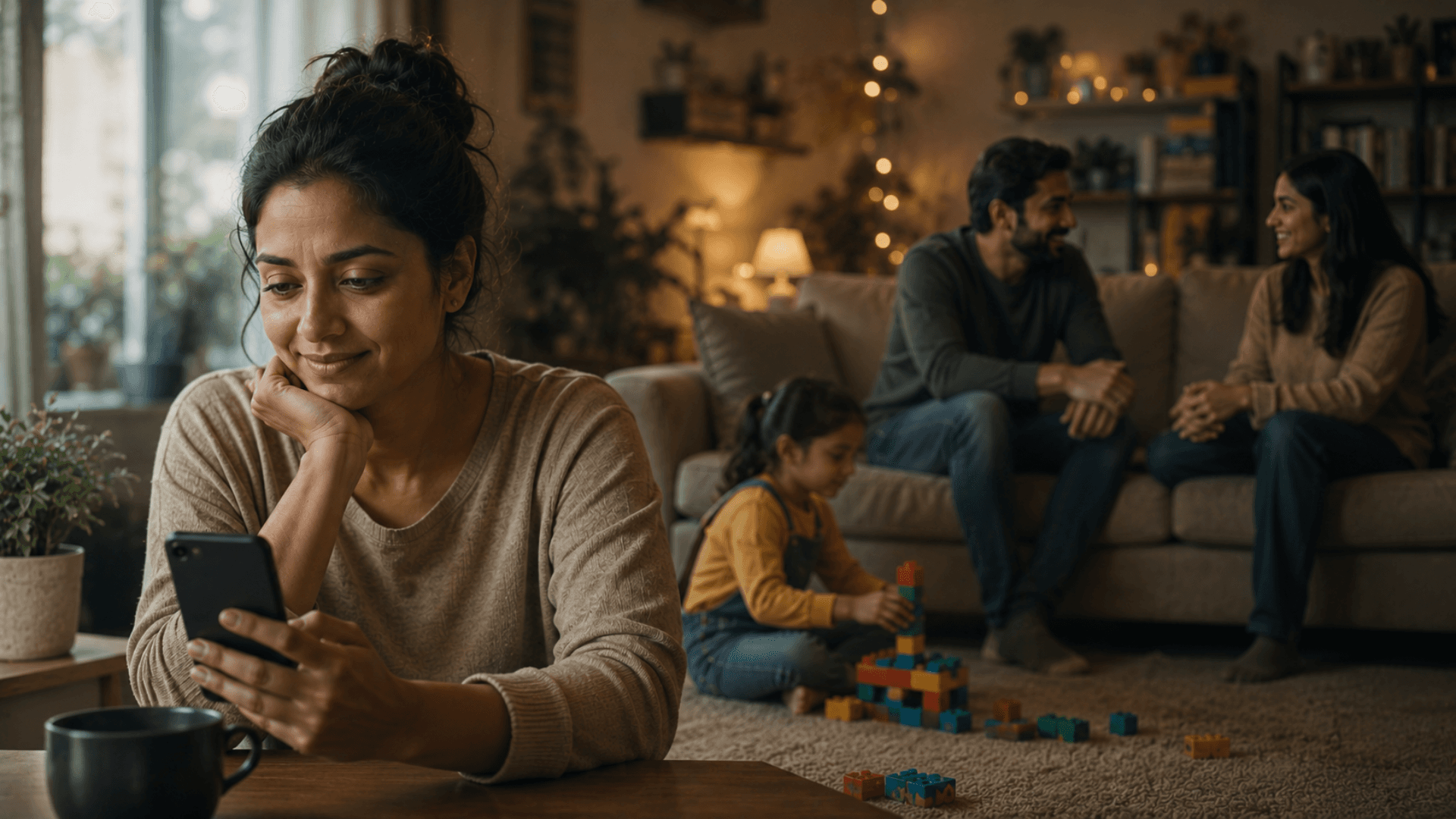
She wants to grab a coffee with a male colleague after a long project wraps up. Nothing more. A thank-you conversation, maybe some career advice, the kind of casual catch-up men have with each other constantly without a second thought.
She thinks about it for longer than she would like to admit. Will he read it as something else? Will he mention it to the team in a way that changes how people look at her? If a mutual friend sees them, what will that friend assume? By the time she has run through the calculations, she has usually just said no thank you, and told herself it was not worth the trouble.
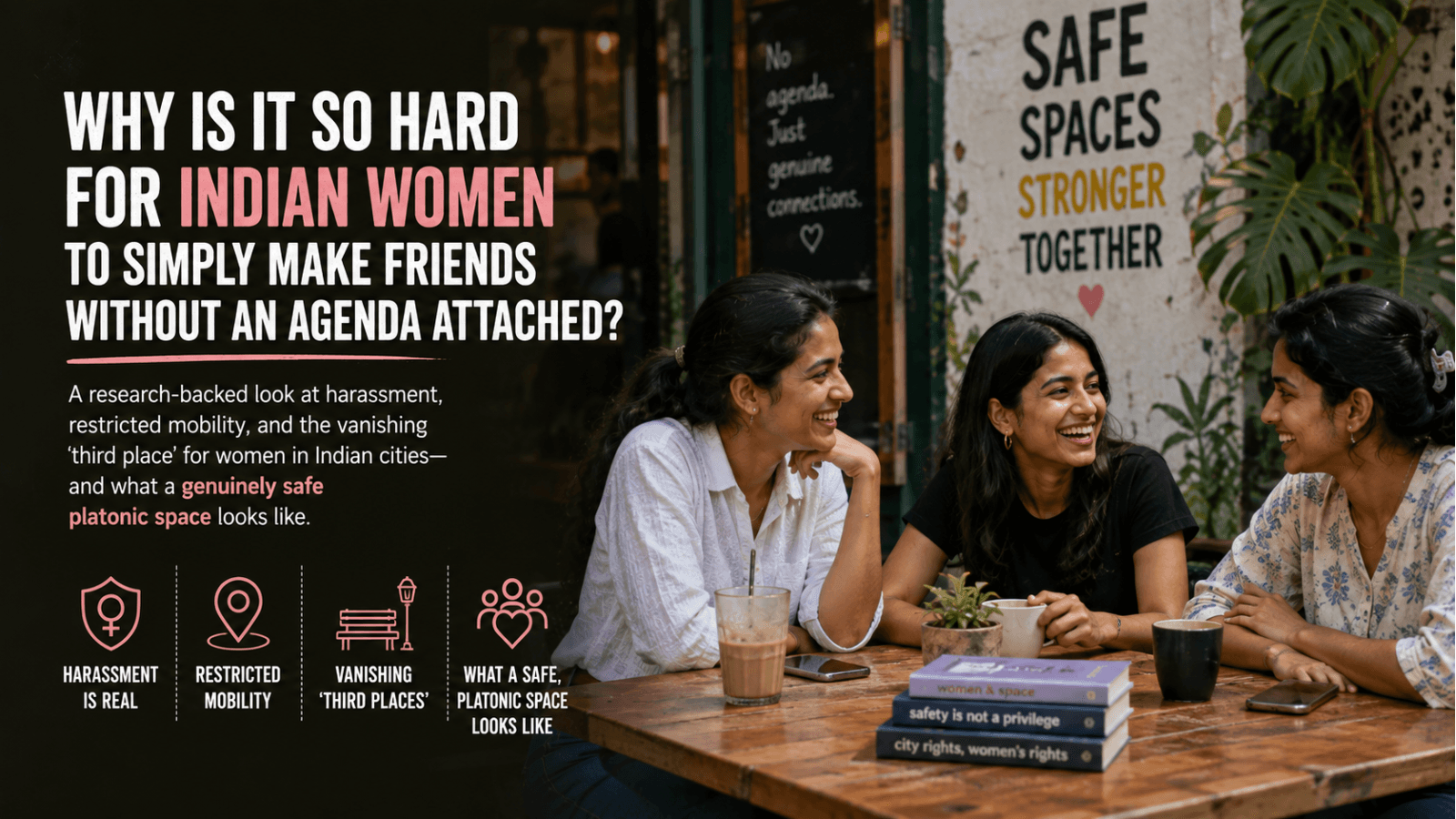
This is not paranoia. It is pattern recognition, built from a lifetime of small data points that taught her exactly how quickly "just friends" gets rewritten into something else the moment a woman is involved. And it is one small example of a much larger, structural problem: platonic social space for Indian women is scarce, heavily monitored, and constantly at risk of being reinterpreted as something it never was.
The Numbers Behind the Hesitation
This is not an isolated feeling. It shows up consistently across independent research.
The National Commission for Women's NARI 2025 report, based on a nationwide perception survey, found that 40 percent of women rated themselves as "not so safe" or "unsafe" in their own city, and while public harassment affected 7 percent of women surveyed over the past year, that figure rose to 14 percent among women under 24 — with neighbourhoods and public transport identified as the most common hotspots. The same report found that two-thirds of harassment incidents go unreported, and only one in four women expressed confidence that authorities would handle a complaint effectively.
Older but widely cited research paints an even starker picture at the city level. A Save the Children survey of 3,000 women and girls in Bengaluru found that 90 percent do not feel safe and fear daily sexual harassment in public spaces, including lewd comments, inappropriate touching, and other forms of assault, and over 86 percent said they feel unsafe using public transport when alone. Perhaps most tellingly for the subject of platonic social space specifically, the same survey found that 83 percent of women do not discuss their fears or actual experiences of harassment with their own families, and 90 percent said they would not approach the police to report an incident.
An earlier ActionAid-commissioned YouGov poll across Indian cities found that nearly four out of five women in India — 79 percent — reported having experienced some form of harassment or violence in public, with the highest concentration among women aged 25 to 35 who were full-time workers or students.
Put together, this is not a story about occasional bad luck. It is a story about a baseline condition that shapes, quietly and constantly, how much a woman is willing to risk in order to simply go out and meet people.
Why This Is Different From "General" Loneliness
It would be easy to fold this into a generic conversation about urban loneliness, but that undersells the specific mechanics at play for women.
The default assumption is danger, not neutrality. When a man walks into an unfamiliar social setting, the baseline assumption — from himself and from others — is usually neutral. When a woman does the same, safety is very often the first calculation, not an afterthought. That extra layer of risk assessment is invisible to nobody except the person carrying it every single time.
Every new platonic contact carries a reinterpretation risk. A male friendship a woman forms is rarely allowed to simply exist as friendship — in the eyes of family, colleagues, or even the man himself, it frequently gets quietly reframed as romantic potential, gossip material, or a reputational liability. This alone eliminates a huge share of the casual, cross-gender friendships that men form effortlessly at work, in hostels, or through hobby groups.
Mobility itself is often gated by permission. Research on women's mobility in urban India has found that women's movement outside the home starts reducing from adolescence and stabilises at a low level from young adulthood onward, with unemployed women being the least likely to make any trip outside the home at all — evidence that the social norms restricting women's movement take hold early and compound over a lifetime. Even for working women with independent incomes, "can I go" is often still a real question, answered by a parent, an in-law, or an internalised sense of what will be judged acceptable.
Family surveillance follows women even after marriage. A study of young married women in Jaunpur district found that women's social networks were strongly embedded within their extended households, with co-residence with a mother-in-law acting as a significant barrier to mobility — the average woman in the study had fewer than one close peer in her own village outside her household. The pattern generalises well beyond that specific district: family structure, not personal preference, frequently sets the outer boundary of a woman's social world.
The "good girl" calculation never fully switches off. Even independent, financially secure, urban working women often continue running a background calculation about how a given outing, friendship, or evening out will be perceived by family, neighbours, or a future in-law's family — a mental tax that men in the same social position simply do not pay.
The Vanishing "Third Place" for Women
Urban sociologists use the term "third place" for the spaces that exist outside home (the first place) and work (the second place) — the cafés, parks, clubs, and community halls where casual, low-stakes social life actually happens. For men in Indian cities, third places have historically been abundant: the chai stall, the evening cricket ground, the friend's terrace, the late-night dhaba.
For women, the equivalent list is dramatically shorter, and every item on it comes with caveats. A café works until it gets late. A park works until it is unfamiliar or unlit. A friend's house works if the friend's family approves of the visit. Even spaces that are technically open to everyone are, in practice, coded as more available to men — walk into most parks after 7 PM and notice who is actually sitting there.
| Social Setting | Typical Access for Men | Typical Access for Women |
|---|---|---|
| Evening park hangout | Largely unrestricted | Restricted after dark; often avoided alone |
| Late dinner with mixed group | Rarely questioned | Frequently requires justification at home |
| Solo travel to a new meetup venue | Assumed safe by default | Route, timing, and transport pre-planned around safety |
| Cross-gender platonic friendship | Read as ordinary | Often reframed as romantic or suspicious |
| Public transport at night | Inconvenient | Actively avoided; alternate, costlier options sought |
| Speaking to a stranger at an event | Low social cost | Weighed against risk of unwanted attention |
This table is not a claim that men face zero friction. It is a description of a consistent, measurable gap — one that means the ordinary, unplanned social contact that builds most adult friendships simply happens less often, and with more calculation, for women than for men.
What Happens When Platonic Space Keeps Shrinking
The effects compound quietly over years, and they rarely look dramatic from the outside.
Friendship circles narrow to "approved" people. College friends, family-vetted acquaintances, and colleagues from safe, well-known workplaces become the entire social world, because branching out into unfamiliar spaces feels like it is not worth the risk calculation.
Independent identity gets tied to a partner or family, not a personal circle. When building an independent friend group takes constant extra effort, many women end up with a social life that exists mainly through a boyfriend, husband, or immediate family — which quietly increases dependence on those relationships for all social and emotional needs.
Isolation gets misread as introversion. A woman who has simply run out of safe avenues to meet new people is often assumed, including by herself, to just be "not very social" — when the actual explanation is closer to a lifetime of structural friction around the very act of showing up.
The mental load becomes invisible, unpaid labour. Constantly calculating routes, timing, company, and perception before every social plan is exhausting in a way that rarely gets acknowledged, because it has become so normalised that women themselves often stop noticing they are doing it.
Real Scenario: Ishita in Viman Nagar
Ishita moved to Pune from Bhopal for a UX design role and spent her first year almost entirely between office and flat. It was not that she disliked people — it was that every alternative felt like a small negotiation. A dating app felt like the wrong tool for wanting platonic friends. A late-night hangout with new colleagues meant explaining a late return to her flatmate's family, who kept a watchful eye out of genuine concern. A solo evening at a new café in an unfamiliar part of the city meant thinking through the return commute before she had even left.
Her mother, a thousand kilometres away, asked the same question every Sunday call: "Koi dost bani?" Any friends yet? Ishita's honest answer stayed no for longer than she wanted to admit.
What eventually broke the pattern was not willpower. It was finding a Stranger Mingle women-heavy hangout — a Saturday afternoon board game session in Viman Nagar, in a public venue, ID-verified attendees, daylight hours, a genuinely mixed but zero-harassment-policy group. The structure did the work that her own judgment alone had been unable to do: it pre-answered the safety question before she even had to ask it.
She went back the following week. By the fourth event, she had a small, recurring group of women she met for weekend walks independently of any organised event — a friend circle that existed entirely outside her workplace and outside anyone else's approval. Her mother's Sunday question finally got a different answer.
What a Genuinely Safe Platonic Space Actually Requires
Calling a space "safe for women" without structural backing is just branding. Genuine safety for platonic socialising requires specific, verifiable design choices, not a slogan.
1. Verification, Not Just a Policy Statement
An ID-verification process before someone can attend an event does more real safety work than a "zero tolerance" line buried in a terms-of-service page. Verification changes who shows up in the first place.
2. Group Formats Over One-on-One Introductions
Group settings distribute social risk and remove the specific vulnerability of being alone with an unfamiliar person. This is precisely why board game nights, treks, and group hangouts do more trust-building work for women than app-based one-on-one matching ever could.
3. Daylight and Public Venues as the Default
Timing and location are not incidental details — they are core safety infrastructure. A well-lit, public, well-populated venue during accessible hours removes several layers of the calculation a woman would otherwise have to run alone.
4. Enforcement, Not Just Rules
A zero-harassment policy only means something if there is a real, fast, visible mechanism for acting on a complaint — hosts trained to intervene, a clear reporting channel, and actual consequences for violations. Policies without enforcement train people to distrust the policy itself.
5. Space That Families Can Understand, Not Just Approve
The goal is not merely getting family sign-off for one outing. It is offering a format — recurring, verified, public, structured — that genuinely addresses the underlying concern families have, so that "I am going to a Stranger Mingle event" stops requiring the same negotiation every single time.
This Is Not a Call to Accept the Restriction — It Is a Call to Design Around It
None of this is written to suggest that women should simply adapt to a smaller social world, or that the burden of solving this belongs to women alone. The deeper problem — a culture that reads women's public presence as inherently more risky, more scrutinised, and more available for reinterpretation — is a collective one, and it deserves to keep being named and challenged directly.
But while that broader cultural shift is slow, structural work, women still need somewhere to actually build a social life today. Waiting for the culture to fully change before rebuilding a friend circle is not a reasonable ask of anyone. What can change immediately is the design of the spaces available — verified, public, group-based, enforced — so that the constant background calculation gets meaningfully lighter, even if it does not disappear overnight.
A safe platonic space is not a small convenience. For a lot of women in Indian cities, it is the entire difference between an independent social life and years spent quietly waiting for permission that was never going to arrive on its own.
If you are a woman in Pune, Mumbai, Bengaluru, Hyderabad, or Delhi who has been running that same background calculation every time a social plan comes up, Stranger Mingle exists specifically to remove as much of that calculation as structure can. Every member is ID-verified. Every event runs in a public setting with an enforced zero-harassment policy. Roughly eight in ten members show up alone the first time — which means you will not be the only one testing the waters.
Explore upcoming events in your city and see what a Saturday afternoon looks like when the safety question has already been answered before you arrive.