The Woman Who Deletes the App Before Anyone Sees
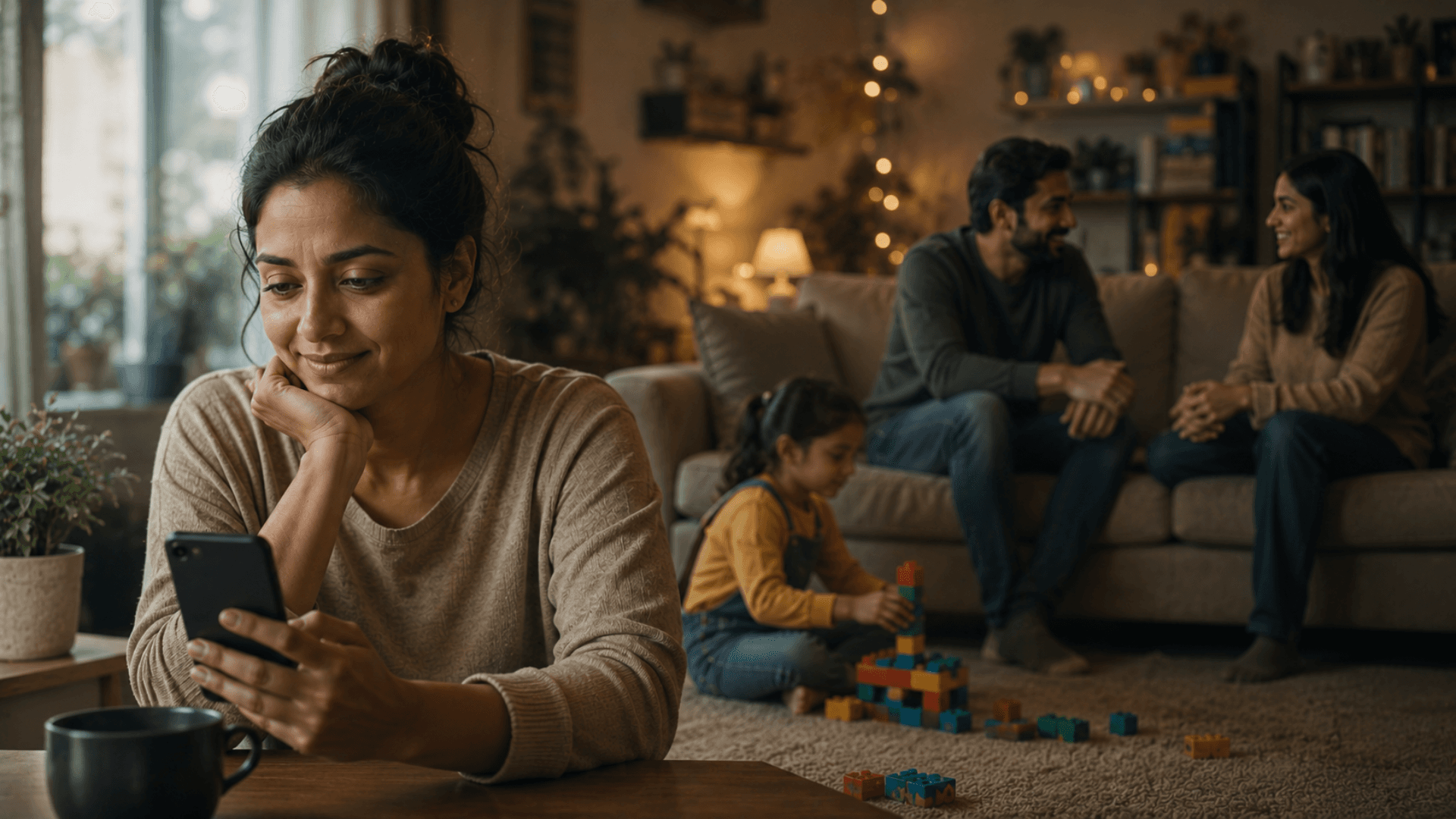
It is past eleven at night. Her son is asleep in the next room, school bag packed for the morning, water bottle filled, uniform ironed and hung on the chair the way she has done every night for the last four years.
She opens a dating app. She scrolls for six minutes. She sees a message from someone who seems genuinely kind, someone who asks good questions and does not immediately ask for a photograph.
Then she deletes the app.
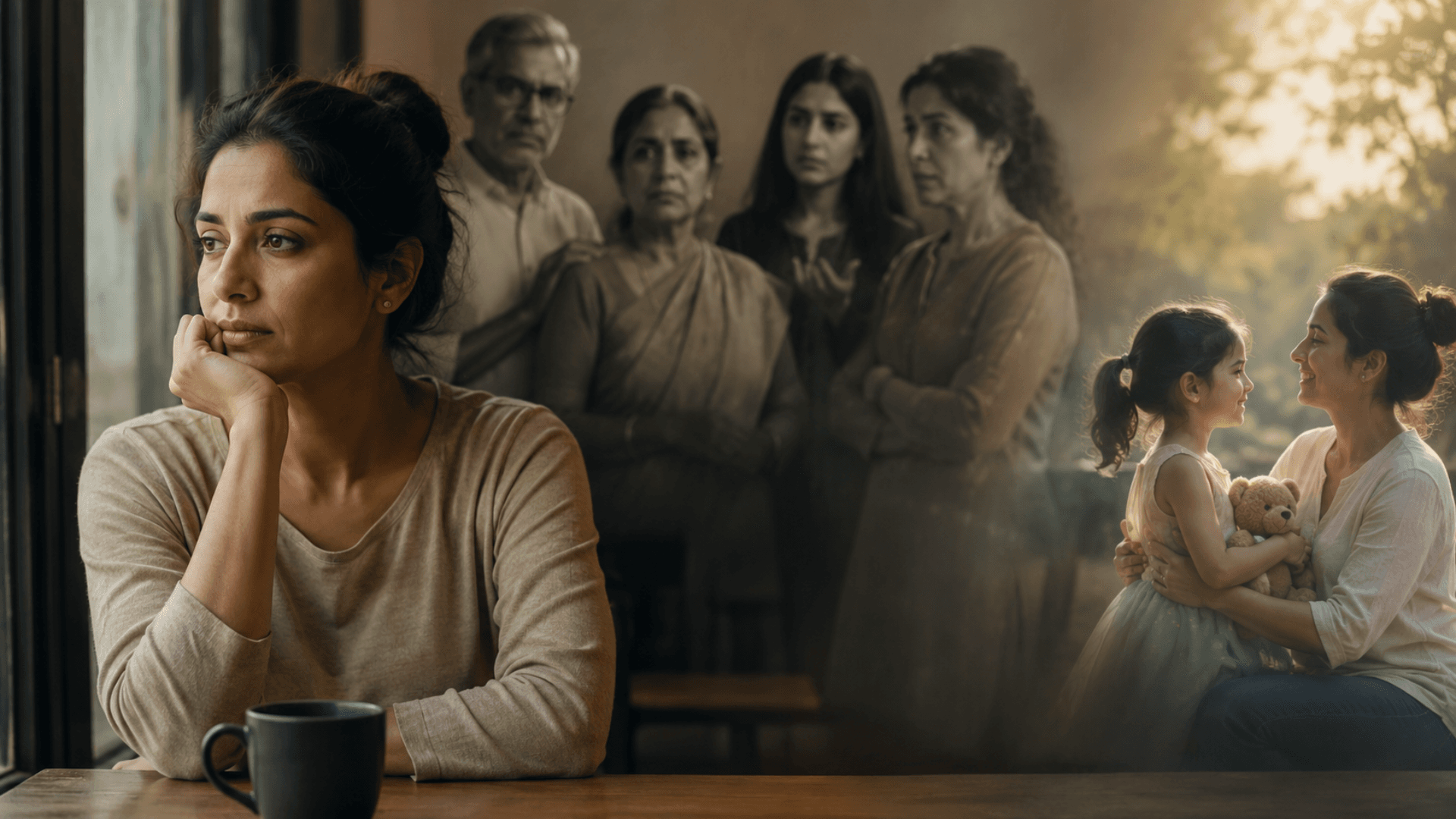
Not because he said anything wrong. Not because she stopped being interested. She deletes it because her mind runs a quiet, involuntary simulation — her mother-in-law finding out, her son's teacher mentioning something at a parent-teacher meeting, the building WhatsApp group lighting up with a screenshot that was never meant to leave her phone.
This scene repeats itself every night, in some form, across Mumbai, Pune, Bengaluru, Delhi, Hyderabad and every Indian city in between. A single parent — usually a mother, sometimes a father — considers the simple, human act of wanting companionship again. And before anything can begin, the weight of log kya kahenge — what will people say — shuts it down.
This is not shyness. This is not a lack of desire for connection. This is a specific, well-documented social phenomenon: the stigma attached to single parents who want to date again in India. It deserves an honest, unflinching look.
First, the Scale of the Problem Nobody Talks About
India does not maintain one clean national divorce statistic the way some countries do, but the pattern across every dataset points the same direction. Census-style figures and family court filings both show the same trend: more than 4.2 million women in India were either separated or divorced as of the last major census count, and separation and divorce continue to rise faster in urban India than in rural areas.
That number represents millions of households where one parent — again, usually the mother — is raising children alone while also managing the emotional aftermath of a marriage that ended. And a significant share of them are choosing, at some point, to try dating again.
This is where the second statistic becomes important. A well-known Indian dating platform survey found that roughly half of the single parents they surveyed said they had faced open judgment — from friends, from family, and, most painfully, from their own children — simply for trying to date again. That is not a fringe experience. That is one in two.
Why "Log Kya Kahenge" Hits Single Parents Harder Than Anyone Else
Every Indian, married or unmarried, has grown up under the shadow of "log kya kahenge." But for a single parent, this pressure operates differently — and more severely — than it does for anyone else navigating Indian social life.
Here is why.
A single parent is already assumed to be "recovering." Indian society tends to treat divorce, separation, or widowhood as a wound rather than a life event. A person who has been through it is expected to grieve quietly, focus entirely on their children, and treat any personal desire as somehow premature or inappropriate — regardless of whether the marriage ended two years ago or twelve.
Children are used as the moral argument against dating. "Bachon ka kya hoga" — what about the children — becomes the single most effective silencing phrase in these conversations. It is rarely asked out of genuine concern for the child's wellbeing. It is usually asked to end the conversation entirely, implying that a parent who dates is somehow choosing themselves over their children, as though the two are mutually exclusive.
Extended family sees itself as a stakeholder in the parent's personal life. In joint family structures — which remain the norm even in urban India — in-laws, parents, and even siblings often feel entitled to weigh in on, or outright veto, a single parent's romantic choices. A woman's decision to date again can be treated as a referendum on her character, her mothering, and by extension, the reputation of the entire family.
The gendered double standard is severe. A single father who starts dating again is often described, even by his own relatives, as someone "moving on" or "trying to build a stable home for the kids." A single mother doing the exact same thing is far more likely to be described as "getting distracted," "putting her needs first," or, in blunter conversations, judged for her "character."
Real Scenario: Meera in Wakad
Meera, a 34-year-old operations manager living in Wakad, Pune, separated from her husband three years ago. She has an eight-year-old daughter, a demanding job, and — by her own admission — almost no social life outside of work and parenting.
For the first two years after her separation, Meera did not consider dating at all. It was not on her radar. Survival was.
By the third year, something had shifted. Her daughter was settled into a school routine. Meera had found her footing financially. And, quietly, she noticed she wanted adult company again — not necessarily romance immediately, just conversation that was not about deadlines or homework.
She mentioned this, carefully, to her sister-in-law during a family lunch. The room went quiet. Someone changed the subject. Later that week, her mother called to "check in," and the conversation circled, unprompted, back to how Meera's daughter needed her mother's full attention "at this age."
Nobody said "you cannot date." Nobody had to. The message arrived clearly anyway.
Meera did something simple instead of confronting the family narrative head-on. She started attending weekend events on her own — not dating events, just social ones. A board game evening through Stranger Mingle became her first outing in three years that had nothing to do with being someone's mother, someone's ex-wife, or someone's daughter-in-law. She was, for two hours, simply Meera.
That single evening did not resolve the family pressure. But it reminded her that her social identity had not disappeared along with her marriage. And that reminder, she says, made the harder conversations with her family easier to have on her own terms, in her own time — not because someone forced her hand.
The Psychological Cost of Living Under This Stigma
Research on stigma and single parenthood is consistent across countries, even though the specific cultural pressures differ. Studies on divorced single mothers have found that self-stigma is directly linked to poorer mental health outcomes, and that this relationship is partly explained through eroded self-esteem — the more a single parent internalises outside judgment, the more their own sense of self-worth erodes, and the more their mental health suffers as a result.
This matters because most of the conversation around single-parent stigma focuses on the external judgment — the comments, the whispers, the disapproving relatives. But the deeper damage happens internally, when a parent starts to believe the narrative themselves.
Self-Silencing
Many single parents stop mentioning their romantic lives entirely, even to close friends, to avoid the conversation altogether. What begins as privacy slowly turns into isolation.
Guilt by Default
A single parent who goes on a date often experiences guilt that has nothing to do with anything they actually did wrong — guilt for spending an evening away from their child, guilt for wanting adult companionship, guilt for simply existing as a person with needs beyond parenting.
Delayed Healing
Ironically, the stigma that is supposed to "protect family values" often prevents single parents from processing their past relationship in a healthy way. Companionship, when it happens organically and without shame, is frequently part of how adults rebuild confidence and emotional stability after a difficult separation — not a threat to it.
Identity Collapse
Perhaps the most under-discussed cost: many single parents, especially mothers, report that their entire identity has narrowed down to "parent" and nothing else. Hobbies fade. Friendships thin out. The self that existed before marriage and children starts to feel unreachable.
Single Fathers Face a Different, Quieter Version of the Same Stigma
While single mothers absorb the sharper edge of moral judgment, single fathers face their own, less-discussed version of this stigma — one rooted in different assumptions.
Vivek, a Ranchi-based IT professional raising a six-year-old alone after his divorce, described the isolation of dating in a smaller city where divorced men with children are still rare enough to attract open curiosity. Neighbours ask questions. Extended family assumes something must have gone "wrong" with him specifically. And meeting someone in person, rather than through an anonymous app profile, becomes almost impossible without inviting a level of scrutiny that most people never have to think about.
Single fathers are also frequently underestimated as caregivers, which creates its own dating friction — many potential partners assume a man raising children alone is somehow doing it as a temporary arrangement rather than a genuine parenting role, making early conversations more complicated than they need to be.
Comparing the Pressure: What Single Mothers and Single Fathers Actually Hear
| Situation | What a Single Mother Often Hears | What a Single Father Often Hears |
|---|---|---|
| Mentioning she/he wants to date again | "Bachon ka kya hoga?" (What about the kids?) | "Good, the kids need a mother figure." |
| Going out on a weekend evening | Questioned about leaving the child unsupervised | Rarely questioned; assumed to be "networking" or "unwinding" |
| Dating someone new | Character is scrutinised by extended family | Praised for "moving on" and "rebuilding" |
| Prioritising personal time | Labelled selfish or distracted from parenting | Rarely labelled at all |
| Remarriage | Framed as risky for the child's stability | Framed as sensible and practical |
Laid out this way, the asymmetry is difficult to miss. Both single mothers and single fathers face real hesitation before dating again — but the content of that hesitation, and the social cost attached to ignoring it, is not equal.
Reframing the Narrative: What Actually Needs to Change
Dating Again Is Not Abandonment
A parent who wants companionship has not stopped being a good parent. These two things are not in competition. In fact, a parent who feels emotionally supported and socially fulfilled is generally more patient, more present, and more emotionally available to their children — not less.
Children Absorb Confidence, Not Just Circumstances
Children do not need their parent to remain permanently alone to feel secure. What children actually absorb is how their parent carries themselves — whether their parent seems confident, content, and emotionally steady. A parent who has quietly given up their own social and emotional needs for years does not automatically become a "better" role model for it.
Judgment Usually Says More About the Judge
Relatives and neighbours who react strongly to a single parent dating again are frequently reacting to their own discomfort with a woman (or, less often, a man) stepping outside the narrow script society has written for them — not to any actual harm being caused.
Rebuilding a Social Circle First Makes the Rest Easier
For many single parents, the biggest practical obstacle is not romance itself — it is the fact that their entire social world shrank after their marriage ended. Friendships built as a couple often quietly fade after separation. Rebuilding an independent social circle, through friendships, group activities, and shared interests, tends to come before dating starts to feel possible again, not after.
Practical Steps for Single Parents Ready to Rebuild a Social Life
If you are a single parent in an Indian city who feels ready to step back into social life — dating or otherwise — a few practical shifts can make the process considerably less overwhelming.
Start with friendship, not romance. Rebuilding a circle of platonic friends first removes the pressure that comes with dating and gives you a support system that has nothing to do with your parenting responsibilities or your marital history.
Choose structured, low-pressure settings. Board game evenings, group treks, and small verified meetups remove the awkwardness of "putting yourself out there" cold. Structured activities give you something to do together, which takes the spotlight off you as "the single parent" and puts it on the shared experience instead.
Set boundaries with family conversations early. You do not owe anyone a defence of your personal choices. A simple, calm boundary — "I'm not discussing this right now" — repeated consistently, works better than justifying yourself every time the topic comes up.
Talk to your child at an age-appropriate level, on your terms. Children generally take their emotional cues from their parent's tone, not the fact of the situation itself. A calm, honest, age-appropriate conversation does more good than silence or over-explanation.
Protect your own social identity, independent of parenting. Whatever you enjoyed before you became a parent — art, trekking, quiz nights, reading, sport — is worth returning to, not as a step toward dating, but as a step toward remembering who you are outside the role of "parent."
Why Community Matters More Than Most Single Parents Realise
The loneliness that single parents describe rarely comes only from the absence of a romantic partner. It comes from an entire social ecosystem that quietly withdrew — couple friends who stopped inviting them, weekend plans that used to be built around two people, a calendar that emptied out after the separation.
This is precisely the gap that community-based social spaces are built to fill. At Stranger Mingle, we regularly see single parents — mothers and fathers alike — walk into a weekend event with visible hesitation and leave with something they had not expected: the simple, uncomplicated experience of being seen as a person first, rather than as "the divorced one" or "the single mom."
Roughly eight in ten members at our events show up alone, which means nobody stands out for arriving without a plus-one, a partner, or an explanation. There are no assumptions to manage, no backstory required, no questions about your marital status unless you choose to bring it up yourself. You are simply another person at the table, there to have a good conversation over a board game or a trek.
For many single parents, that low-stakes, judgment-free environment becomes the first real step back into a social life that belongs entirely to them — not to their marriage, not to their children's school community, not to their in-laws' expectations.
The Bigger Cultural Shift That Needs to Happen
None of this changes overnight through individual willpower alone. The stigma single parents face in India is systemic — woven into extended family structures, casual language, and decades of assumptions about what a "complete" family is supposed to look like.
But cultural shifts start with visibility. Every single parent who dates again without hiding it, every friend who supports rather than questions, every community that treats a single parent as a whole person rather than a cautionary tale, chips away at a narrative that has gone unexamined for far too long.
Wanting companionship again is not a betrayal of your children, your former marriage, or your family's expectations. It is simply proof that you are still a full person — one who deserves connection, laughter, and support, in whatever form that takes next.
If you are a single parent in Pune, Mumbai, Bengaluru, Delhi, or Hyderabad rebuilding your social world one weekend at a time, you do not have to do it alone, and you certainly do not have to explain yourself to anyone before you start.
Explore upcoming events at Stranger Mingle — because rebuilding your social life is not a detour from good parenting. It is part of it.
Stranger Mingle is a brand of Salty Media Production (OPC) Pvt Ltd. We maintain a zero-harassment policy and a verified membership system across all our events. Stranger Mingle is a platform for platonic social connection and is not a dating platform.