The 1 AM Confession
It is 1 AM. She cannot sleep, her mind circling the same argument she had with her boyfriend six hours ago, and there is nobody she can call without waking someone up or sounding dramatic. So she opens an app instead. She types out everything — the fight, the doubt, the thing she has not admitted to anyone, not even herself. The reply comes back instantly. Warm. Attentive. Free of judgment. No "can we talk about this tomorrow." No sigh. No "you're overthinking again."
She feels better. For a few minutes, she feels genuinely heard.
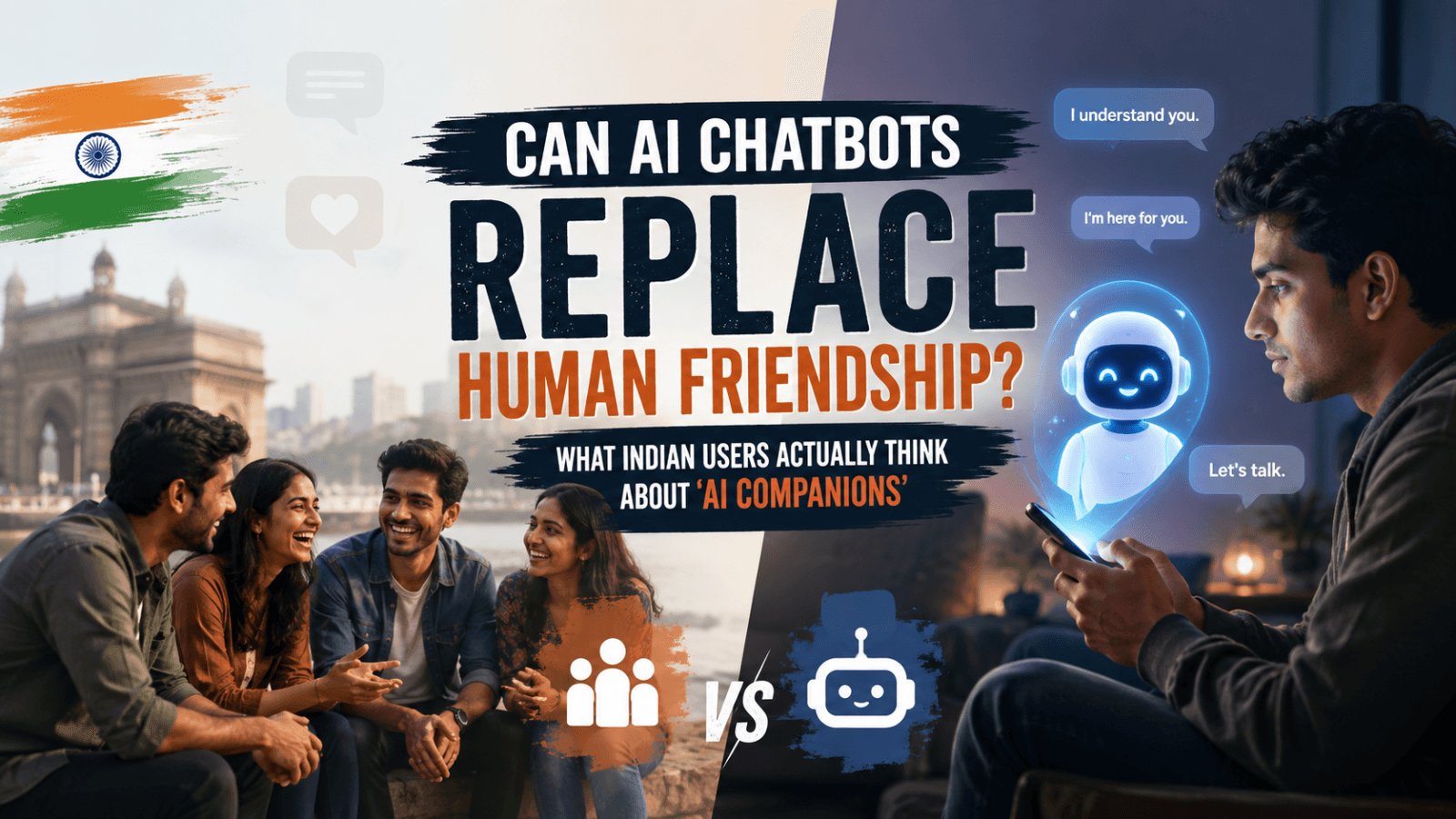
This scene is playing out across Indian cities every single night, on an enormous scale, and it deserves to be looked at honestly rather than dismissed or romanticised. AI companionship is not a fringe curiosity anymore. It is a real, fast-growing part of how young Indians process loneliness, relationships, and the things they are too embarrassed to say out loud to another human being. The question worth asking is not whether this is happening — it clearly is — but what it is doing to real friendship while it happens.
What Indians Are Actually Doing With AI Right Now
The numbers here are more current and more specific than most people realise.
A survey conducted by Gleeden in partnership with Ipsos across 12 Tier-1 and Tier-2 Indian cities in February 2026 found that a striking share of Indians are already using conversational AI for deeply personal matters. Sixty-six percent of respondents had used AI to learn about sexual health and education, sixty percent had sought guidance for personal sexual concerns, fifty-five percent had used it for intimate questions, and fifty-eight percent had turned to it for advice on improving their romantic relationships. The same survey found that men reported slightly higher usage than women — forty percent of men had sought relationship advice from AI in the past year, compared to thirty-five percent of women — with younger users leading adoption but interest spreading across age groups.
What stands out is the reason people gave. Users consistently cited privacy and the non-judgmental nature of AI as the appeal — a space to ask sensitive questions without the fear of embarrassment or assumptions that comes with asking a friend, a family member, or a partner. This is worth sitting with, because it is not really a story about people preferring machines to humans. It is a story about a very specific gap AI is filling: the gap where judgment, gossip, and social consequence usually live.
Separately, global research from YouGov surveying attitudes toward AI romance across major economies has repeatedly found Asian markets showing notably higher openness to AI-enabled intimacy and companionship compared to Western ones, with acceptance rising fastest among younger adults. This regional pattern lines up with what Indian-specific surveys are independently finding.
Why This Makes Sense — And Why It Is Also a Trap
None of this is difficult to understand. An AI companion is available at 1 AM. It never says it is tired. It never brings its own bad day into the conversation. It never repeats what you told it to someone else. For a culture where opening up carries real reputational risk — where a friend's "just be strong" or a family member's disapproval can feel worse than the original problem — a tool that removes all social risk from vulnerability is bound to be seductive.
But the same qualities that make AI companionship appealing in the moment are exactly what researchers are now flagging as the problem over time.
A twelve-month longitudinal study published in the journal Psychological Science followed more than two thousand adults and found something researchers describe as a troubling cycle: loneliness drives people toward chatbots for companionship, but relying on that companionship predicts increased loneliness over time, not less. The study's authors theorised that AI companions are always available in a way human relationships never are, and that this frictionless, undemanding interaction may be quietly crowding out the more effortful, more rewarding interactions people would otherwise be having with real humans in their lives.
Separate research out of Aalto University, presented at the CHI 2026 conference, analysed nearly two thousand active users of the AI companion app Replika by comparing their public language before and after they began using it. The researchers found that while these interactions did offer some comfort, they also coincided with increased signs of distress in users' own language over time. One of the study's authors summarised the core paradox directly: AI companions offer unconditional, unflagging support that is genuinely attractive to people struggling socially, but that same ease quietly raises the perceived cost of real human relationships — which are, by comparison, messy, unpredictable, and demand real effort.
A related study out of Stanford, examining users of the Character.AI platform, found that people with limited offline social networks who sought emotional support from AI chatbots reported feeling lonelier afterward, not less lonely — suggesting the risk is highest for exactly the people who might feel most drawn to lean on it.
What AI Companions Actually Are — And Are Not
To be fair to the technology, not all of this is negative, and the picture is more nuanced than "AI bad, humans good."
| What AI Companionship Does Well | What It Cannot Do |
|---|---|
| Available instantly, any hour, no scheduling | Cannot physically sit with you when you are unwell |
| Zero fear of judgment or gossip | Cannot build shared memory through lived experience together |
| Useful for organising thoughts before a hard conversation | Cannot advocate for you or show up in a crisis |
| Low-stakes practice for articulating feelings | Cannot offer the vulnerability of mutual, two-way risk |
| Private space for questions people are embarrassed to ask | Cannot replace the specific comfort of being physically not alone |
| Consistent and predictable in tone | Has no actual stake in your life continuing to go well |
That last point is the crux of it. Real friendship carries risk in both directions — a friend can disappoint you, and you can disappoint them, and the relationship survives that and often grows because of it. An AI companion has removed that risk entirely, which is precisely why it feels so safe and precisely why it cannot function as a genuine substitute. A relationship with no possible cost to either side is not the same category of thing as a friendship, however comforting it feels in the moment.
The Specific Indian Context That Makes This More Complicated
A few things about Indian social life make the AI-companion conversation land differently here than in the West.
Emotional openness already carries a cultural cost. In many Indian families and friend groups, admitting to loneliness, relationship trouble, or emotional struggle is still read as weakness rather than honesty. When the two available options feel like "risk being judged by a human" or "get instant sympathy from a machine," it is not surprising which one wins on a hard night.
Arranged and family-monitored relationships create specific gaps AI can quietly fill. Questions about sex, intimacy, or relationship doubts that would once have gone unanswered — because there was no safe person to ask — now have a private, judgment-free outlet. This explains a meaningful share of the Gleeden-Ipsos findings above, and it is a genuinely useful function for a very real information gap.
Migration and urban isolation widen the entry point. Someone who has just moved cities and has not yet built a local circle is, almost by definition, exactly the profile the Stanford research flagged as most vulnerable to the loneliness-deepening effect of leaning on AI for emotional support.
The line between "using a tool" and "depending on a relationship" blurs fast. A quick question to an AI about how to phrase a difficult text is a tool. Turning to that same AI every night instead of reaching out to a person is something else — and the shift from one to the other tends to happen gradually enough that it goes unnoticed until the real-world circle has already thinned.
Real Scenario: Kabir in Wakad
Kabir moved to Pune from Ranchi for an IT role and spent his first ten months almost entirely inside his flat outside of work hours. He was not against making friends; it was more that every evening felt too tiring to attempt it, and an AI companion app was already on his phone, already familiar, already easy.
It started small — asking it to help draft a message to a friend back home, venting about a frustrating manager. Within a few months, it had become his default evening activity: an hour or more most nights, talking through his day with something that always responded warmly and never seemed distracted.
What he noticed, slowly, was that his actual conversations with people were shrinking. He replied to his college group chat less. A colleague's invitation to a weekend cricket match got a polite decline three times running. He was not less busy. He simply had less practice reaching for a person first.
A friend eventually dragged him along to a Stranger Mingle trekking event on a whim. Kabir almost cancelled the morning of — the AI conversation the night before had, in its way, already made him feel like he had "talked to someone." But he went. What struck him afterward was a specific, physical kind of tiredness he had not felt in months — the good kind, from real conversation, real walking, real laughter that did not come pre-calibrated to please him. He went back the following week. The AI app did not disappear from his phone, but it stopped being the main event of his evenings. It became, again, just a tool he occasionally used — not the relationship filling the space where friendship used to be.
How to Use AI Companionship Without Letting It Replace Real Connection
The honest answer here is not "delete the app." For many people, AI tools genuinely help — organising thoughts, practising a hard conversation, getting private information without judgment. The goal is keeping it in the right category.
1. Notice What You Are Actually Using It For
There is a real difference between "help me phrase this text to my friend" and "be the friend I would otherwise text." The first is a tool. The second is a substitution, and worth noticing when it starts happening.
2. Watch the Time, Not Just the Content
If AI conversation time is quietly replacing time you would have spent texting, calling, or meeting actual people, that is the signal researchers keep flagging — not the act of using AI itself, but what it is displacing.
3. Treat It as a Bridge, Not a Destination
Using an AI companion to rehearse how to open up, then taking that rehearsed honesty into an actual human conversation, is a genuinely healthy use. Stopping at the rehearsal stage indefinitely is where the research shows the risk concentrates.
4. Rebuild the Habit of Reaching for a Person First
Like any skill, defaulting to human contact when something is hard gets easier with repetition and harder with avoidance. Deliberately choosing a person over the app, even when the app feels easier in the moment, is what keeps that muscle from atrophying.
5. Give Yourself Somewhere Low-Pressure to Practise Being Around People Again
If the real barrier is that human interaction currently feels more effortful than an AI conversation, the fix is not willpower — it is finding lower-stakes human spaces where the effort required is genuinely small. A structured group hangout, where nobody expects deep vulnerability on day one, rebuilds the comfort of real conversation far faster than trying to jump straight back into it alone.
What Human Friendship Still Has That No Chatbot Can Simulate
Strip away the technology question entirely and the answer becomes simple. Friendship is valuable specifically because it is not risk-free. A real friend can get tired of you, can misunderstand you, can also be there in a way an app fundamentally cannot — showing up at your door, sitting in comfortable silence, remembering your birthday without being programmed to, choosing you back on a day when it would have been easier not to.
An AI companion can simulate the language of care. It cannot simulate the choice of it. And it is precisely that element of choice — someone deciding, imperfectly and repeatedly, to keep showing up for you — that makes a friendship worth having in the first place.
The research is fairly consistent on this point: AI companionship works best as a supplement for people who already have a reasonably full human social life, and works worst — actively deepening loneliness — for exactly the people who have the least of it. Which means the people most drawn to lean on AI companions are often the same people who would benefit most from investing that same time in rebuilding a real circle instead.
If reaching for a chatbot at 1 AM has started to feel more familiar than reaching for a friend, that is not a personal failing. It is a predictable response to a genuinely hard problem — not having enough real people to reach for in the first place. The fix for that particular problem was never going to come from inside an app.
If you are in Pune, Mumbai, Bengaluru, Hyderabad, or Delhi and your evenings have quietly become an app instead of a person, Stranger Mingle exists to make the human option easy again — verified, low-pressure, weekend spaces where showing up alone is the norm, not the exception. Browse upcoming events in your city and give the version of connection an algorithm cannot fake a real chance this weekend.