The 11 PM Kitchen
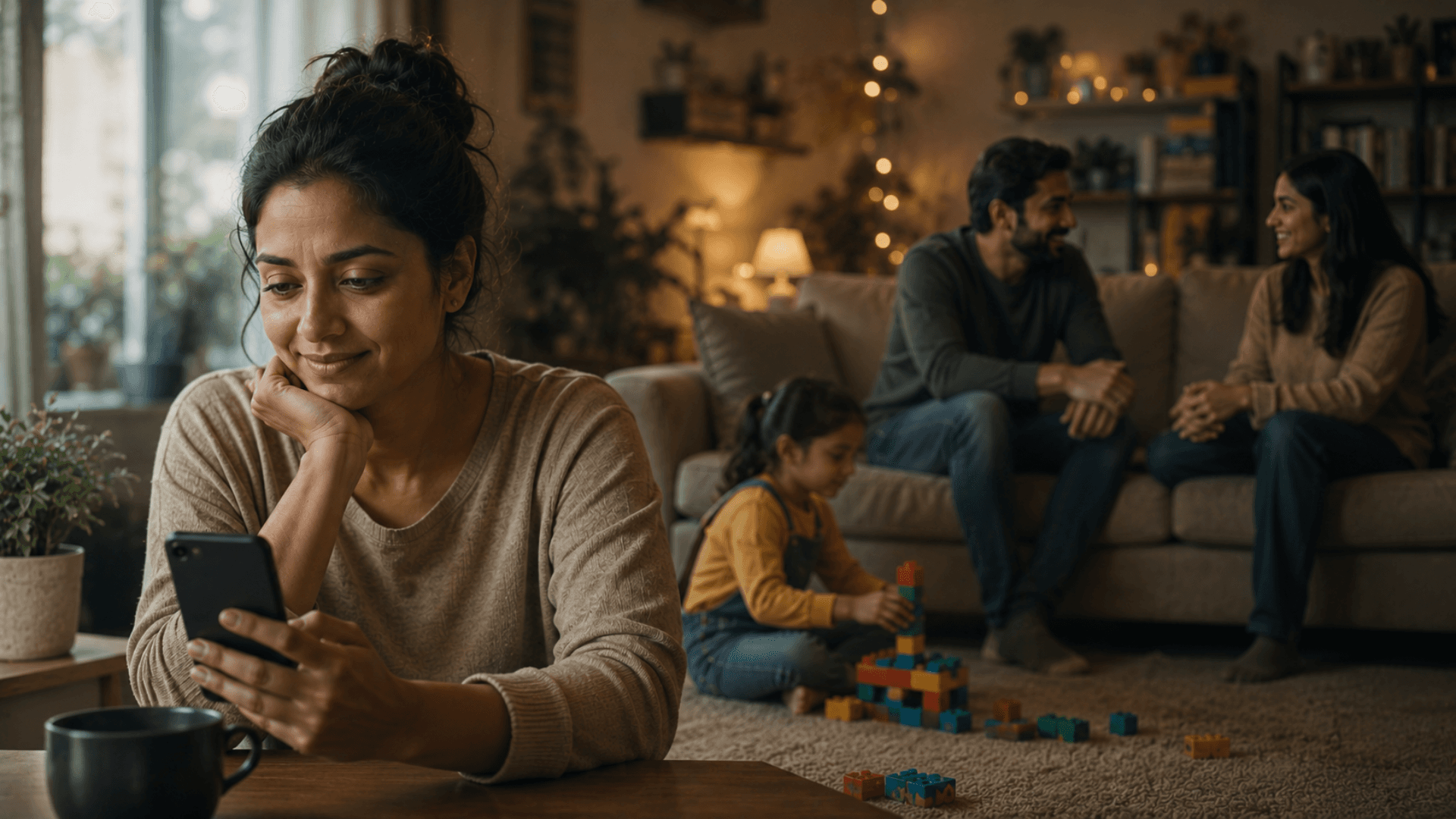
It is 11 PM on a Tuesday and Ananya is sitting at her kitchen counter in Powai, Mumbai, with a laptop open to work she did not finish and a phone she has not touched in three hours because there is nobody left to text.
Her eight-year-old is asleep. The dishes are done. The house is quiet in a way that used to feel peaceful and now just feels empty.
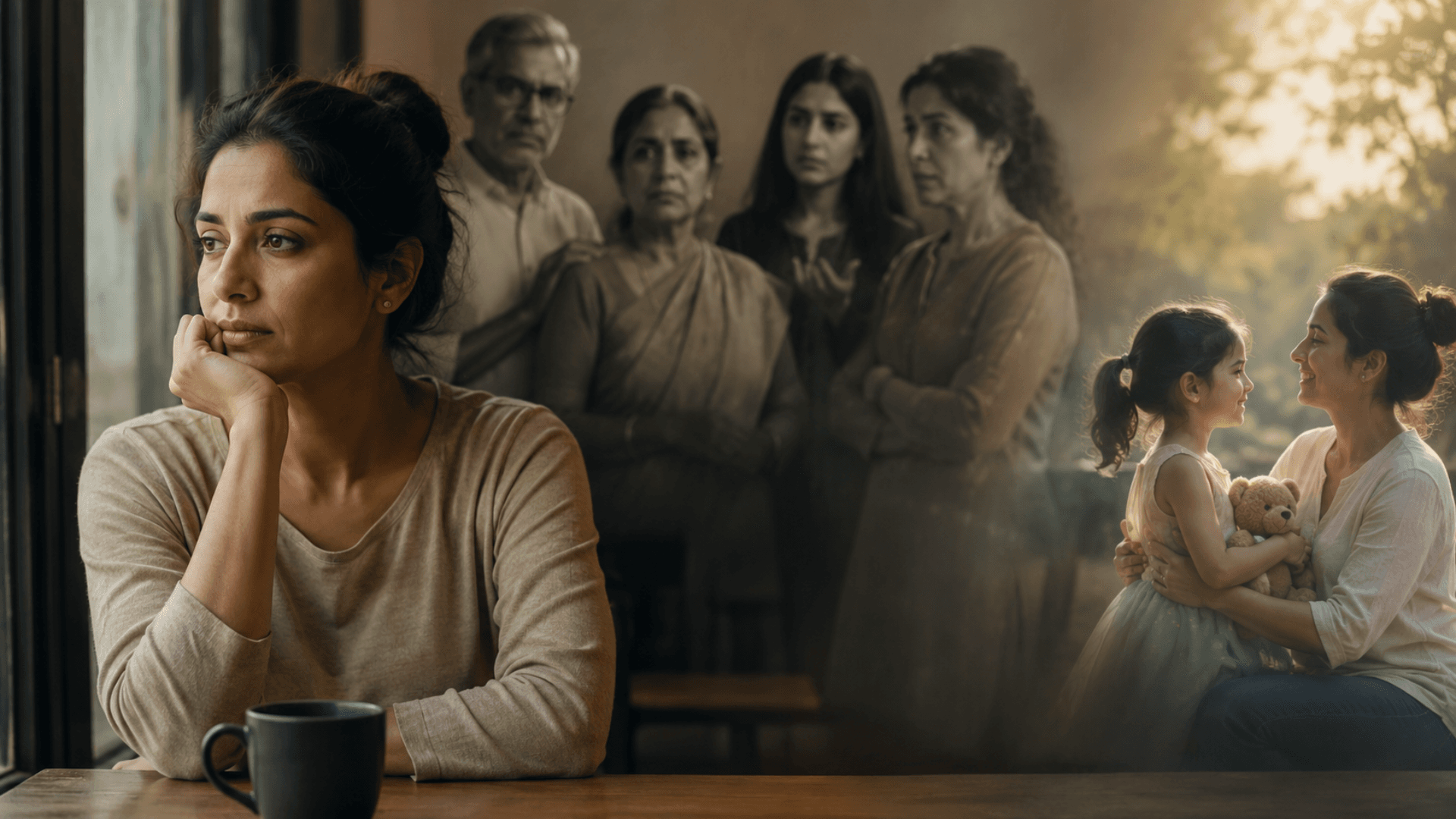
She is not thinking about her ex-husband tonight. She is thinking about Priyanka, who used to be her closest friend, and who stopped calling somewhere around the second year after the divorce. Not out of cruelty. Just — awkwardness. Priyanka's husband and Ananya's ex used to play badminton together on Sundays. When the marriage ended, the foursome quietly dissolved, and nobody quite knew how to keep half of it.
Ananya is not lonely because she lacks love for her son. She adores him completely. She is lonely because somewhere in the last three years, her adult world got very, very small.
This is not a rare story. It is one version of a pattern playing out in flats and PGs and family homes across Pune, Bengaluru, Delhi, Hyderabad, and every other Indian city where marriages end, partners pass away, or people choose to raise children on their own. And almost nobody talks about the specific, layered emotional weight that comes with it.
It is time we did.
Who We Are Actually Talking About
Single parenting in India is more common than the surrounding silence suggests. According to Census of India data, roughly 9.5 percent of Indian families are lone-parent households — headed by a widowed, divorced, or separated parent — with single mothers significantly outnumbering single fathers in this group. That number has only grown as urban divorce rates rise and joint family structures continue to loosen their grip on how Indian households are built.
But statistics do not capture what this actually feels like from the inside. A government-backed study of single mothers across four Indian metro cities, conducted under the Ministry of Women and Child Development, found that economic strain was only part of the burden — emotional isolation and social stigma weighed just as heavily on the women interviewed. Research comparing single and married mothers has consistently found that single parents report far less emotional and social support and far more unstable social networks than their partnered peers.
This piece is not only for single mothers, though they carry a disproportionate share of both the parenting and the stigma in India. It is for single fathers too — a smaller but growing group who face their own, less-discussed version of isolation, often without the language or social permission to admit they are struggling at all.
The Guilt Nobody Warned You About
If there is one emotion that single parents describe more consistently than any other, it is guilt. Not one guilt — several, layered on top of each other.
Guilt about the marriage ending. Even when separation was the healthiest decision, even when the relationship was harmful, many parents privately wonder if they failed to try hard enough, or failed to give their child the two-parent household that Indian culture holds up as the default and the ideal.
Guilt about needing anything for yourself. A single parent who wants an evening out, a weekend away, or simply an hour of adult conversation often feels a flash of shame before they even finish the thought. Shouldn't I be with my child right now? Am I being selfish? This is one of the most corrosive and least examined parts of single-parent guilt — the belief that your own needs are inherently in competition with your child's, and that choosing yourself, even briefly, is a small betrayal.
Guilt about your child's confusion or pain. Watching a child ask why their friend has two parents at the school gate, or notice an empty chair at a birthday dinner, produces a very specific ache — the fear that your circumstances, not your choices, are shaping your child's understanding of what family is supposed to look like.
Guilt about moving on. For separated or widowed parents who eventually date again or consider remarriage, a fresh layer of guilt often appears — as though building a new relationship somehow dishonours the child's other parent, living or not.
None of this guilt is a sign that something is wrong with you. Guilt, in this context, is usually a sign of how much you care — inflated by a culture that has historically treated the two-parent household as the only acceptable template for raising a child. Recognising that the guilt is disproportionate to any actual wrongdoing is often the first real step toward carrying it more lightly.
Why the Friend Circle Shrinks
Divorce, separation, and loss do not just end a relationship. They frequently end a social ecosystem that was built around that relationship — and this is one of the least discussed griefs of single parenting.
Research into loneliness among Indian household heads found something striking: people with a marital status other than "currently married" reported loneliness at nearly three times the rate of those who were married, and the effect was strongest among people now living without a partner in the home. The isolation is not incidental. It is structural.
Consider what actually happens after a marriage ends or a partner dies:
- Couple friendships often do not survive. Friend groups built around two families spending time together frequently split unevenly, or dissolve altogether, because it feels logistically and emotionally complicated to maintain them with only one parent present.
- Weekend routines disappear. The dinners, the trips, the casual Sunday plans that used to happen automatically as a couple now require the single parent to actively rebuild a social life from scratch — while also handling parenting largely alone.
- Extended family relationships can turn strained. In many Indian families, in-laws and even one's own relatives quietly withdraw after a divorce or separation, sometimes out of discomfort, sometimes out of unspoken judgment.
- New friendships feel harder to start. Making friends as an adult is already difficult in Indian cities. Making friends as a single parent — with limited time, limited energy, and the added self-consciousness of explaining your situation — feels significantly harder.
The result is a specific kind of isolation: not being physically alone, since you have your child, but being socially and emotionally alone in a way that has nothing to do with how much you are loved by the people already in your life.
What This Actually Does to a Single Parent's Mental Health
The consequences of sustained isolation and guilt are not abstract. Multiple Indian studies on single mothers have documented meaningfully elevated rates of depression and loneliness compared with married mothers, alongside significant financial and social strain. A wider review of research on single mothers across South Asia found that social stigma, financial pressure, and emotional isolation combine to increase vulnerability to anxiety and prolonged stress — with cultural attitudes in many communities still framing single mothers as social outliers rather than simply parents raising their children.
Here is what this can look like day to day:
| The Silent Struggle | How It Often Shows Up |
|---|---|
| Chronic guilt | Overcompensating with the child, difficulty resting or relaxing, constant self-monitoring |
| Social isolation | Fewer close friendships, declining invitations, avoiding events that feel "for couples" |
| Emotional exhaustion | Irritability, low patience, feeling "touched out" by end of day |
| Suppressed grief | Difficulty processing the end of the marriage or loss of a partner while simultaneously parenting |
| Identity loss | Feeling like "just a parent" with no space left for who you were before |
| Reluctance to seek help | Fear of judgment, cost concerns, or simply not having the time to prioritise therapy |
What makes this particularly difficult is that single parents are often the last people to prioritise their own mental health, precisely because they feel entirely responsible for someone else's wellbeing. The parent becomes so focused on shielding the child from disruption that their own emotional needs get pushed indefinitely down the list.
Real Scenario: Karan in Gurugram
Karan, a 34-year-old product manager, became a single father after his wife passed away when their daughter was four. For the first year, he ran on pure momentum — school drop-offs, work deadlines, bedtime routines, repeat.
What nobody told him was how specifically isolating widowed single fatherhood would be. His married friends did not know how to include him anymore; dinner invitations quietly stopped feeling natural once he was "just Karan and Mira" instead of a couple. His own parents, grieving too, leaned on him for support rather than offering it. He did not have a single person he could call at 9 PM just to talk about his day, the way he used to with his wife.
He describes the loneliness as "not sad exactly — more like being invisible." People saw him as a devoted single father, which he was. Almost nobody saw him as a 34-year-old man who also needed friendship, adult conversation, and a life outside the role of "parent."
Karan eventually started attending a weekend Stranger Mingle circle in Gurugram, initially just to get out of the house on a Saturday his daughter spent with her grandparents. He did not go looking for anything specific. He found, over a few months, a small group of people he could genuinely call friends — people who knew him as Karan, not only as Mira's father.
That distinction mattered more than he expected. Because a single parent who has even one space in their week that is entirely their own tends to come back to parenting steadier, less depleted, and less resentful of the role they never stop playing.
Practical Ground: What Actually Helps
Validating the weight of single parenting matters, but validation alone does not lighten the load. Here is what genuinely helps, based on both clinical guidance and lived patterns among single parents.
Therapy, Without the Stigma
Professional support remains underused among Indian single parents, largely due to stigma and the assumption that therapy is only for "serious" problems. Reviews of single-mother mental health research consistently point to a gap between the emotional support single parents rely on informally and the professional help they actually access. Therapy is not an admission of failure. It is one of the few spaces where a single parent can process guilt, grief, and exhaustion without managing anyone else's feelings about it.
Support Groups and Peer Communities
Talking to other single parents — people who understand the guilt without needing it explained — reduces the isolation that generic social circles often cannot. Peer groups, whether formal support groups or informal WhatsApp communities of single parents in your city, offer something therapy alone cannot: the simple relief of not being the only one.
Boundary-Setting With Family and Ex-Partners
Guilt often grows in the space where boundaries are missing — saying yes to every request from extended family, absorbing every unresolved conflict with an ex-partner, never protecting time that belongs only to you. Clear, calm boundaries are not selfish. They are what make sustainable single parenting possible.
Rebuilding a Social Life That Is Not "Extra"
This is the piece most single parents deprioritise first and need most urgently. A social life is not a luxury layered on top of parenting responsibilities — it is part of what keeps a parent emotionally resourced enough to parent well. This does not require hours of free time. It requires small, consistent choices: one evening out a month, one recurring activity, one space where you show up as yourself.
Letting Go of the Guilt Around Needing Adult Connection
Wanting friendship, laughter, and adult company is not a betrayal of your child. Children raised by parents who have their own steady, supported emotional lives consistently do better than children raised by parents running on empty. Meeting your own needs is not the opposite of good parenting. It is a requirement of it.
Why Community Matters More Than It Gets Credit For
At Stranger Mingle, we see this pattern show up regularly across our weekend circles in Pune, Mumbai, Bengaluru, Hyderabad, and Delhi — adults who are not looking for romance, not looking to network, simply looking for a room where they can exist as themselves for a couple of hours. A meaningful number of the people who walk into our board game nights, treks, and heritage walks alone are parents rebuilding a social identity that got quietly dismantled by divorce, separation, or loss.
Roughly eight in ten of our members show up solo, and single parents make up a consistent share of that group — arriving without a plus-one, without an agenda, and usually without expecting to leave with new friends. But that is what tends to happen. Structured, low-pressure group settings remove the two hardest parts of adult friendship-making for a single parent: the logistics of planning something one-on-one, and the vulnerability of walking into a room with no one they know.
Nobody at a Stranger Mingle circle needs to know your custody arrangement or the reason your marriage ended. You are simply a person who showed up — funny, curious, tired on some days, fully present on others. For a lot of single parents, being seen as a whole adult again, even for one evening, is quietly restorative in a way that is hard to name until you feel it.
You Are Allowed to Rebuild
If you are a single parent reading this, here is the thing worth sitting with: the guilt you carry is not proof that you are doing something wrong. It is proof of how seriously you take a responsibility that was never meant to be carried entirely alone — not by design, not by any culture's original intention, and certainly not by yours.
Your loneliness is not a character flaw. It is a structural gap — the natural consequence of friend circles built for couples, of a culture still catching up to how many families no longer fit the two-parent template, and of a role that asks enormous amounts of you while offering very little space to ask for anything back.
Seeking therapy, joining a support group, setting a boundary with family, or simply showing up alone to a Saturday afternoon meetup are not small things. They are the beginning of building a life that has room for your child and for you.
If you are looking for a low-pressure place to start rebuilding that adult social world — no explanations required, no judgment, just people — explore upcoming Stranger Mingle events in your city. Come as you are. Most people do it alone. You will not be the only one.
Stranger Mingle is a brand of Salty Media Production (OPC) Pvt Ltd. We run a zero-harassment policy across all our events, with ID-verified membership and safety protocols designed for everyone, including solo attendees. Stranger Mingle is not a dating platform — it is a community platform built for genuine, platonic connection.