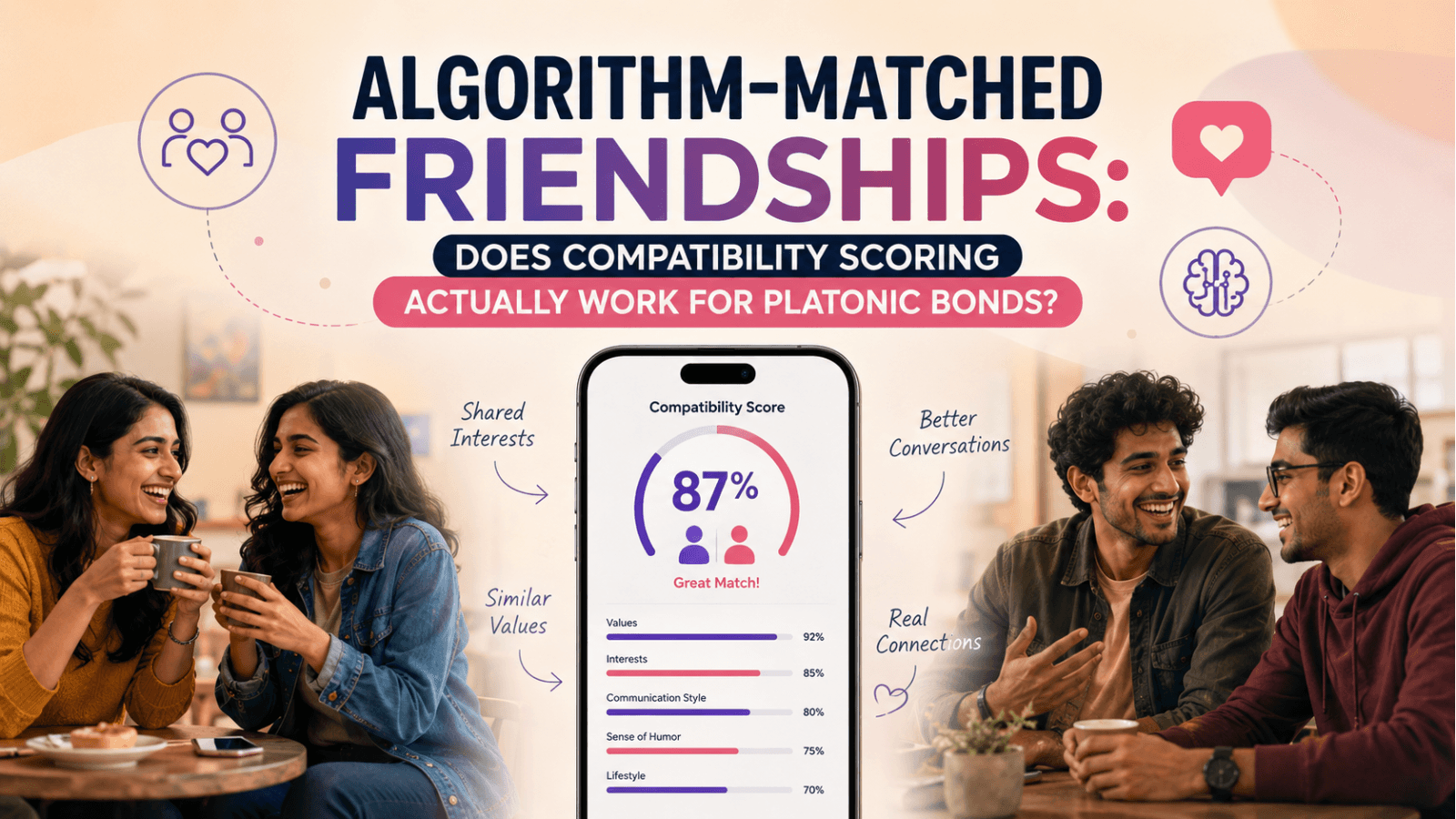
94% Compatible, Zero Percent Conversation
You fill in the quiz. Books you like, weekend habits, whether you are a morning person, how you take your chai. The app churns through it and delivers a verdict: 94% compatible. A face appears with a bio that reads eerily similar to your own — same shows, same hobbies, same "looking for genuine friendships not just small talk."
You message. She replies. Two exchanges in, the conversation runs out of road the way small talk always does. Neither of you suggests meeting. The chat sits unread for a week, then quietly disappears from your recent list, the same way the last four "94% compatible" matches did.
This is the honest, unglamorous reality behind most algorithm-matched friendship attempts, and it is worth asking directly: does compatibility scoring actually produce friendships, or does it just produce a very convincing-looking list of people you will never actually become close to?
What "Compatibility Scoring" Is Actually Built On
Every friendship-matching app, and the compatibility layer bolted onto general social apps, runs on some version of the same idea: if two people share enough interests, values, and lifestyle traits, an algorithm can predict they will get along, and a high score should translate into a real bond.
This idea is not baseless. Decades of psychology research on interpersonal attraction do confirm that similarity of attitudes, values, and background is a powerful influence on interpersonal attraction, and people are indeed more likely to become friends if they share common interests, goals, and pastimes. The same body of research has also fairly conclusively found that the popular idea that "opposites attract" does not hold up — attraction and friendship formation grow stronger with similarity, not difference.
So the underlying premise of compatibility scoring is not wrong. The problem is what happens when you try to turn that premise into a product.
Why the Compatibility Score Fails to Predict Real Chemistry
This is where the research gets genuinely uncomfortable for anyone who has ever trusted a "match percentage."
In a widely cited 2017 study, researchers led by psychologist Samantha Joel built a machine learning model trained specifically to predict romantic desire using established relationship-science variables — the same category of self-reported traits that compatibility algorithms rely on. The finding, reported in reviews of algorithmic matching research, was that while the algorithm offered some indication of a person's general selectivity and desirability, it was unable to anticipate which specific pairs of people would actually hit it off once they met in person. The same review notes plainly that scientists remain skeptical of matching algorithms' ability to predict long-term relationship success, because the forces behind real compatibility are complicated and depend on far more than the individual traits each person brings into the interaction.
There is an even stranger finding buried in this research. In one well-documented set of internal experiments at the dating platform OkCupid, engineers deliberately told bad matches they were highly compatible and told good matches they were poorly compatible — and people responded to the stated score, not the underlying calculation, suggesting that belief in a match mattered more than the match itself. Academic research on this phenomenon has a name for it: the placebo effect of algorithmic matching. A large longitudinal study found that people who believed an algorithm was effective at finding compatible matches were significantly more likely to report a successful outcome, regardless of what the algorithm actually did behind the scenes.
In plain terms: the score itself is doing far less work than the confidence it creates in the person reading it.
What Actually Predicts Whether Two People Become Friends
If compatibility scores are not the real engine of friendship, what is? Friendship science has a fairly consistent, decades-old answer, and it has almost nothing to do with a quiz.
| Factor | What the Research Shows | What This Means for Apps |
|---|---|---|
| Proximity | Repeated physical closeness is one of the strongest predictors of friendship formation, even more than shared traits | Apps that never bring people into the same room cannot replicate this |
| Repeated exposure | Familiarity built through seeing the same person multiple times accelerates trust and liking | A single swipe-match, with no repeat contact, provides almost none of this |
| Shared activity | Doing something together, rather than only talking about shared interests, builds bonds faster than conversation alone | Text-first matching skips this step entirely |
| Reciprocal vulnerability | Friendship deepens through a mutual, gradually escalating exchange of openness over time | A 24-hour messaging window undercuts the "gradual" part of this process |
| Natural similarity | Similarity does matter, but it appears to work best when discovered through shared experience, not declared upfront in a bio | A stated 94% match front-loads a claim that has not actually been tested by real interaction |
Classic research on friendship formation in housing developments found that residents consistently became closer with the neighbour living directly next door than with someone only slightly further away — even when the physical distance involved was almost trivial. Proximity, it turns out, does more work in building friendship than most people assume, and no compatibility percentage can substitute for it.
More recent work adds an important wrinkle. A study conducted at boarding schools found that while social networks naturally cluster around people with similar backgrounds, deliberately increasing physical proximity between dissimilar students produced meaningfully more diverse friendships than similarity alone would predict — suggesting that proximity does not just support friendship between similar people, it actively creates connections between people who would never have matched on a compatibility quiz in the first place. This is a direct challenge to how algorithmic matching works: by filtering for similarity upfront, a compatibility score may be quietly closing off exactly the kind of unexpected, proximity-driven friendship that tends to be the most rewarding.
Why "Matched, Then Message" Breaks Down for Platonic Bonds
The mechanics of most friendship-matching apps were borrowed wholesale from dating apps, and that borrowing is a big part of the problem.
Reviews of the most widely used platonic-matching app in this category describe a consistent pattern: users match based on a photo and a short bio, exchange a few messages within a limited time window, and the conversation fizzles before it ever becomes a real plan. One detailed review of the format noted that the format's structure — a countdown timer for the first message, designed to create urgency for romantic interest — simply does not translate to platonic connections, where people approach a new stranger friendship with more caution and less built-in motivation to move fast. Another reviewer who used the same kind of app for a year described matching with genuinely nice people and having good early conversations that nonetheless "felt more like temporary companions" and quietly faded over time, because nothing about the format supported the sustained, repeated contact that turns an acquaintance into a friend.
There is also a deeper structural issue: a compatibility score answers "do we share traits" but says nothing about "what kind of friendship do we each actually want." One reviewer put this well — everyone on a friendship app says they want a friend, but that word means wildly different things to different people: a coffee-every-few-months friend, a daily-texting friend, a workout-partner friend. No score captures this, and the mismatch usually only becomes visible after several stalled conversations have already used up the goodwill that got the match started.
Real Scenario: Riya in Baner
Riya downloaded a platonic-matching app after eight months in Pune spent almost entirely between her flat in Baner and her office. She matched with a handful of women who, on paper, looked like near-perfect friends — same taste in books, same fondness for weekend treks, same complaints about long commutes.
She had five or six conversations that started warm and went nowhere. Everyone was polite. Nobody suggested meeting. Two matches simply stopped replying after a few days, with no explanation, in the specific way that only happens on an app where the other person has fifteen other conversations running in parallel and nothing at stake in keeping any particular one alive.
What eventually worked was almost the opposite approach. A colleague mentioned a Stranger Mingle heritage walk happening on a Saturday near Baner — no compatibility quiz, no match percentage, just a public event with a fixed group and a shared activity already built in. Riya went, mostly out of curiosity about the venue rather than any expectation about the people.
She did not click with everyone there. That was fine — nobody expected her to. But she did click with two women, and the reason had nothing to do with a declared shared interest and everything to do with the ordinary mechanics of proximity: they happened to be walking near each other for two hours, made a joke about the tour guide's pace, and kept talking afterward over chai because the group naturally stayed together. She saw both of them again at a board game night three weeks later. That second encounter — pure repeated exposure, nothing algorithmic about it — is what actually turned the acquaintance into a friendship neither compatibility quiz had managed to produce in eight months of trying.
Where Compatibility Information Can Still Help — If Used Right
None of this means compatibility data is useless. It means it is being asked to do a job it was never suited for.
Compatibility filtering works as a starting filter, not a finish line. Knowing someone likes trekking or board games can reasonably narrow down who you are likely to meet at a given kind of event — but the actual bond still has to be built through repeated, shared, in-person contact afterward, not concluded by the filter itself.
A shared activity does more matching work than a shared interest listed in a bio. Two people who both wrote "loves hiking" on a profile have a stated similarity. Two people who are actually hiking together, sweating up the same slope, sharing water, navigating the same wrong turn, have a lived one — and lived similarity is what the research shows actually predicts closeness.
Group formats sidestep the reciprocity mismatch problem entirely. A one-on-one algorithmic match requires both people to independently decide to invest effort at the same time, which is fragile. A group event only requires you to show up once; the format itself generates the repeated, low-pressure contact that friendship actually needs, without either person having to carry the entire initiative alone.
The Honest Verdict
Compatibility scoring is not a scam, but it is also not doing what it claims to do. The underlying psychological premise — that similarity supports friendship — is real. What breaks down is the leap from "we are similar on paper" to "therefore we will become friends," a leap the actual mechanics of friendship formation — proximity, repeated exposure, shared activity, and gradually built trust — simply do not support skipping.
A 94% match score can tell you two people might get along in theory. It cannot make them stand in the same room, walk the same trail, or sit through the same slightly awkward first twenty minutes that every real friendship has to survive before it becomes comfortable. That part still has no algorithmic shortcut. It only happens through showing up, more than once, in the same physical space as other people — which is precisely the mechanism that structured, in-person, group-based events are built around, and that no quiz has yet managed to replace.
If your last few friendship-app matches fizzled out after two polite messages, that is not a sign you are hard to match. It is a sign the format was never built to finish the job it started. Stranger Mingle skips the compatibility quiz entirely and goes straight to the part that actually works — real people, in the same room, doing something together, more than once. Roughly eight in ten members show up alone the first time, which means the room is already full of people in exactly your position.
Browse upcoming events in your city and let proximity do what a percentage score never could.