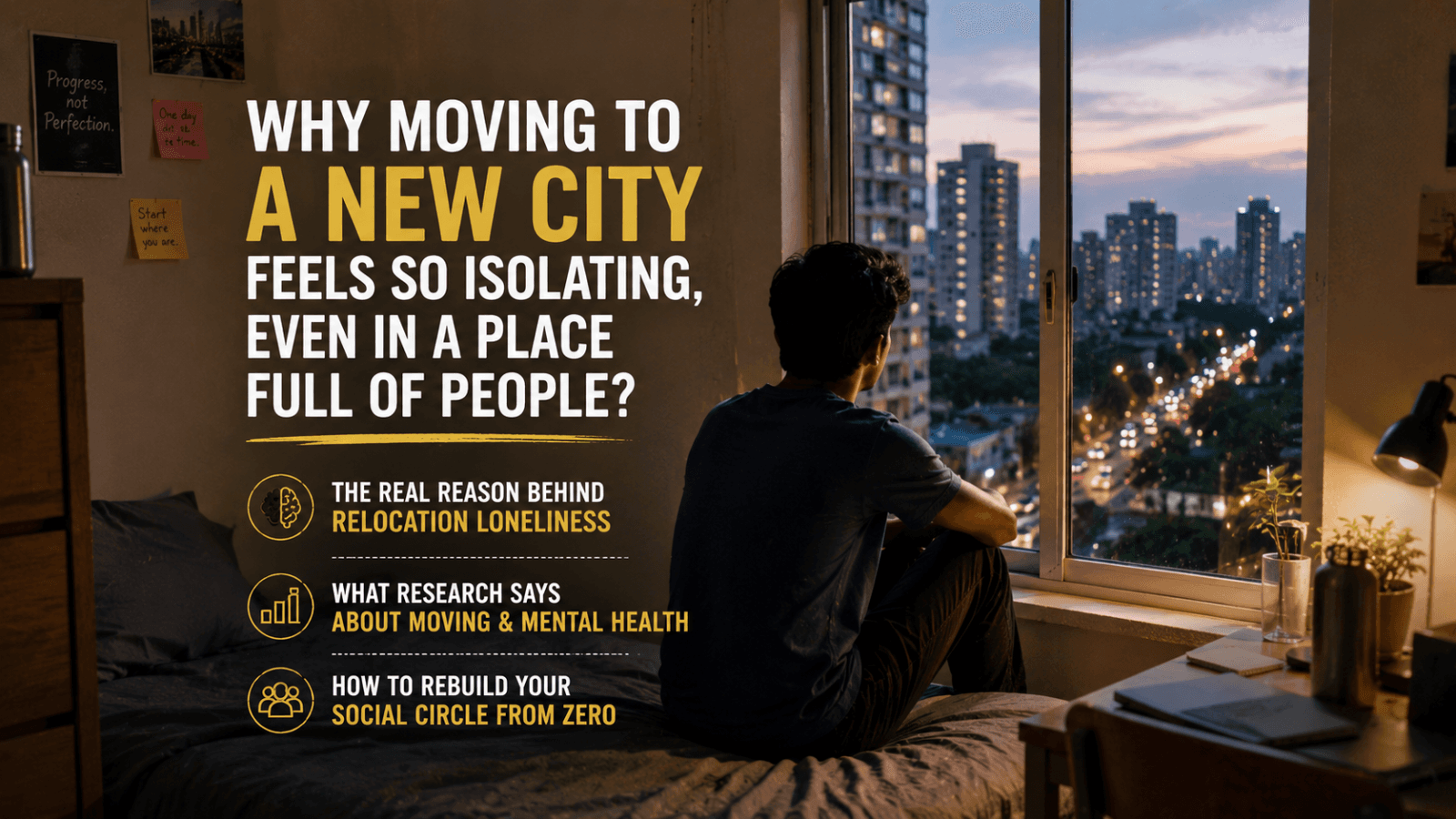
The 9 PM Silence Nobody Warns You About
You unlock the door of your new flat. The lights are still the landlord's tubelight, harsh and slightly flickering. There is a mattress on the floor, two boxes you have not opened, and a fridge with nothing in it except a bottle of water and half a jar of pickle your mother packed for you.
It is 9 PM on a Tuesday. Back home, this would have been the hour of noise — your mother calling you for dinner, your father's television turned up too loud, a cousin dropping by unannounced, a neighbour's dog barking at nothing. Here, in Pune or Bengaluru or Gurugram, there is nothing. Just the hum of the fridge and the sound of traffic three floors below.
You check your phone. Nobody has texted. You open Instagram and scroll past people who look like they are living full, connected lives, and you close the app because it makes the silence feel worse, not better.
This is relocation loneliness. It has a name, it has been studied, and it is far more common than most people admit out loud.
Why Moving Cities Hits So Much Harder Than Anyone Expects
Nobody prepares you for this. The narrative around moving for a job or a college seat is almost entirely about opportunity — the better salary, the better campus, the bigger city, the independence. Nobody mentions that you are also quietly dismantling every support system you had and starting again with zero.
Research on internal migration in India backs up what you are feeling. Young workers who leave their primary social groups — family, community, and hometown networks — often struggle to build new, meaningful connections, and cities such as Bengaluru, Gurugram, Pune, and Hyderabad are now widely described as sitting inside a genuine loneliness epidemic among the working young. This is not a personal failing. It is a structural, city-wide pattern.
The same holds for students. A qualitative study of young migrant students in South India found that relocating for higher education routinely produces emotional loneliness, a struggle for belonging, and real difficulty adjusting because of homesickness, cultural differences, and social exclusion.
And for young women specifically, migration researchers have flagged loneliness as serious enough to affect not just mental health but career outcomes — a University of Pennsylvania-linked study of young female migrant workers in India was designed around the premise that unaddressed loneliness can quietly limit how well a person settles into a new city, a new job, and a new life stage.
So if you have been telling yourself you should be "fine" by now because it has been three months, six months, even a year — that expectation was never realistic. Loneliness researchers distinguish between different types: emotional loneliness (missing a close attachment figure), social loneliness (lacking a wider circle), and situational loneliness triggered specifically by transitions like migration. Moving cities activates all three at once. That is a genuinely heavier load than most people give it credit for.
The Specific Ways Relocation Loneliness Shows Up
It rarely looks dramatic. It looks like small, repeated moments that quietly compound.
- Eating most meals alone, often standing near the kitchen counter or in front of a laptop, because sitting at a table for one feels worse.
- Weekends with no fixed plan, which start as "finally, some rest" and turn into a low, formless kind of dread by Sunday evening.
- Talking to your parents on video call more than you talk to anyone in your actual city.
- Saying yes to every work happy hour, not because you enjoy them, but because they are the only social contact on the calendar.
- A festival or your birthday arriving in a city where nobody around you registers the date the way people back home would.
- Feeling like you have to perform being "settled and busy" on social media while the truth is closer to isolation.
None of this means something is wrong with you. It means your social infrastructure — the one you built over years, sometimes decades, without even trying — got left behind, and a new one has to be built with deliberate effort, on purpose, from zero.
Why Adult Friendship Formation Is Genuinely Harder Than It Was in College
There is a reason making friends at 24, 27, or 30 feels so much more effortful than it did at 19.
| Factor | College or School Years | Adult Working Life in a New City |
|---|---|---|
| Proximity | Same hostel, same classroom, daily forced contact | Own flat or PG, different colleagues, different commute times |
| Repetition | You saw the same faces five days a week for years | You may see a colleague for eight hours and then not again for a week |
| Shared unstructured time | Free periods, canteen hours, hostel nights | Almost no unstructured time; every hour is scheduled |
| Low stakes for approaching strangers | Normalised — everyone was new once, together | Feels socially risky; adults rarely approach strangers without a reason |
| Existing common ground | Same syllabus, same exams, same age | Nothing assumed in common except geography |
Social psychology research on friendship formation consistently points to two ingredients that adult life quietly removes: repeated unplanned contact, and enough accumulated hours together. Communication researcher Jeffrey Hall's widely cited friendship-formation studies found that acquaintances typically need somewhere around 40 to 60 hours of shared time before a relationship shifts into a genuine friendship, and casual friendships can take over 90 hours to firm up. College gave you those hours automatically, through timetables and hostel corridors. Adult city life gives you almost none of them unless you build a structure that manufactures repeated contact on purpose.
This is precisely why simply "meeting people once" rarely works. A single coffee with a colleague, a single wedding introduction, a single dating app match who turns into a friend — these are starting points, not friendships. What actually builds a circle is showing up to the same kind of room, with at least a partially overlapping group of people, again and again, until familiarity turns into comfort and comfort turns into trust.
Real Scenario: Ankit in Hinjewadi
Ankit moved from Kanpur to Pune eighteen months ago for a software role in Hinjewadi. The job was everything he had worked toward — a good package, a respected company, real career growth. But six months in, his evenings had settled into an identical, grinding pattern: office, traffic on the Hinjewadi-Wakad stretch, a Swiggy order, his laptop, sleep.
His flatmates were two colleagues from a different team who kept different hours. His college friends were scattered across Bengaluru, Noida, and back home in Kanpur, and their group chat had slowly gone quiet the way group chats do when everyone's calendars stop aligning. He told himself this was just what your late twenties looked like. Busy. Independent. Fine.
What actually changed things was small and almost accidental. A colleague forwarded him a link to a Stranger Mingle trekking event happening one Sunday near Pune, mostly as a passing suggestion. Ankit almost did not go — showing up alone to something with strangers felt more effort than staying in. But he went.
Nobody there knew each other particularly well either. That was the point. Within a few weeks, he was part of a loose WhatsApp group from that trek, showing up to a board game night, then a weekend hangout in Baner. It was not instant. It took about four or five events before the group stopped feeling like "an event I attended" and started feeling like "people I know." But eighteen months of near-silence had, within two months, turned into a Sunday cricket-watching group and a standing badminton slot.
Ankit's story is not exceptional. It is the ordinary, unglamorous mechanism by which most adult friendships in a new city actually form — not through a single perfect connection, but through repeated, low-pressure, structured contact with a group.
What Actually Works: A Practical Approach, Not Generic Advice
Most advice on this topic stops at "put yourself out there," which is true and also almost useless without a mechanism. Here is what genuinely moves the needle, based on both research and what we observe at scale across our own community events.
1. Choose Structure Over Willpower
Relying on motivation to "go be social" fails because motivation fluctuates and loneliness itself lowers it further — this is a well-documented, self-reinforcing loop. Structure removes the decision. A recurring Sunday trek, a fixed weekly board game night, a standing class — these work because you do not have to decide to be social each time; you simply have to show up to something already scheduled.
2. Prioritise Repeated Contact Over One-Off Meetings
Given how many hours friendship formation genuinely requires, one dinner with a near-stranger will rarely become a friendship on its own. Look for formats that bring a semi-consistent group of people together more than once — the same trekking community, the same weekend hangout circuit, the same hobby class — rather than chasing a new one-time event every week.
3. Lower the Stakes of Showing Up Alone
The single biggest thing that stops people from rebuilding a social circle in a new city is the discomfort of walking into a room alone. This is exactly why community formats built around "come alone, most people do" work better than formats that assume you already have a plus-one. When everyone in the room is in the same position, the usual social risk disappears.
4. Separate Colleagues From Friends, Deliberately
Office friendships are convenient but often collapse the moment someone changes jobs or teams. It genuinely helps to build at least one social circle that exists completely outside your workplace — one where nobody knows your manager, your appraisal cycle, or your job title. It changes the texture of the conversation entirely.
5. Treat the First Few Months as Infrastructure-Building, Not Failure
If you are three months into a new city and still feel like you have "no one," that is not evidence that something is wrong with you. It is the expected, well-documented shape of relocation. The people who end up with strong circles a year later are not the ones who felt less lonely at month three — they are the ones who kept showing up to the same few structured spaces anyway.
For Women, Specifically: Safety and Loneliness Are Linked
For young women who have moved cities alone, the loneliness question often comes tangled with a safety question — which spaces are actually safe to walk into as a stranger, which events have real verification, which rooms will not turn into an unwanted set-up.
This is worth naming directly rather than glossing over. Isolation and unsafe social environments feed each other: when the safe options feel scarce, many women simply opt out of trying to build a social life at all, and the loneliness deepens. Verified, ID-checked, zero-harassment spaces — where a woman can attend a trek or a board game night without having to manage anyone's expectations beyond a normal, platonic evening — remove that specific barrier. It is a small design choice with a large effect on who actually shows up.
When Loneliness Needs More Than a Social Circle
It is worth being honest about something: while rebuilding a social circle genuinely helps most people who feel isolated after a move, persistent loneliness that comes with a low mood, disrupted sleep, appetite changes, or a loss of interest in things you used to enjoy is worth discussing with a mental health professional. Relocation stress and clinical depression can look similar on the surface but are not the same thing, and there is no shame in seeking that support if the low period is not lifting. Organisations such as iCall (a free psychosocial helpline run by TISS) and Vandrevala Foundation's helpline offer confidential support for exactly this kind of transition-related distress.
Rebuilding Is Slower Than It Feels Like It Should Be — And That Is Normal
If there is one thing worth taking away from all of this, it is that a strong social circle in a new city is not something that happens to you. It is something built, deliberately, one repeated Sunday at a time, usually slower than you would like and faster than it feels while you are in it.
The good news is that the mechanism is well understood and entirely replicable. It does not require a rare personality trait or an unusually outgoing nature. It requires showing up to the same kind of room a handful of times, giving it the hours that friendship actually needs, and choosing structured, low-pressure spaces over waiting for connection to arrive on its own.
That fridge with nothing in it, that 9 PM silence — they are not permanent features of your new city. They are simply what week one looks like, before the structure exists yet.
If you have just moved to Pune, Mumbai, Bengaluru, Hyderabad, or Delhi and are staring down exactly this kind of quiet evening, you do not have to engineer your social life alone from scratch with no starting point. Every week, Stranger Mingle runs verified, zero-harassment weekend events across these cities — treks, board game nights, heritage walks, hangouts — built specifically for people who are new to a city and tired of eating dinner alone. Roughly eight in ten members show up solo the first time. That is not the exception. That is the entire premise.
Browse upcoming events in your city and pick one this weekend. Not because one event will fix the loneliness overnight, but because it is the first of the repeated Sundays that eventually will.