The Feed That Made Her Feel Alone
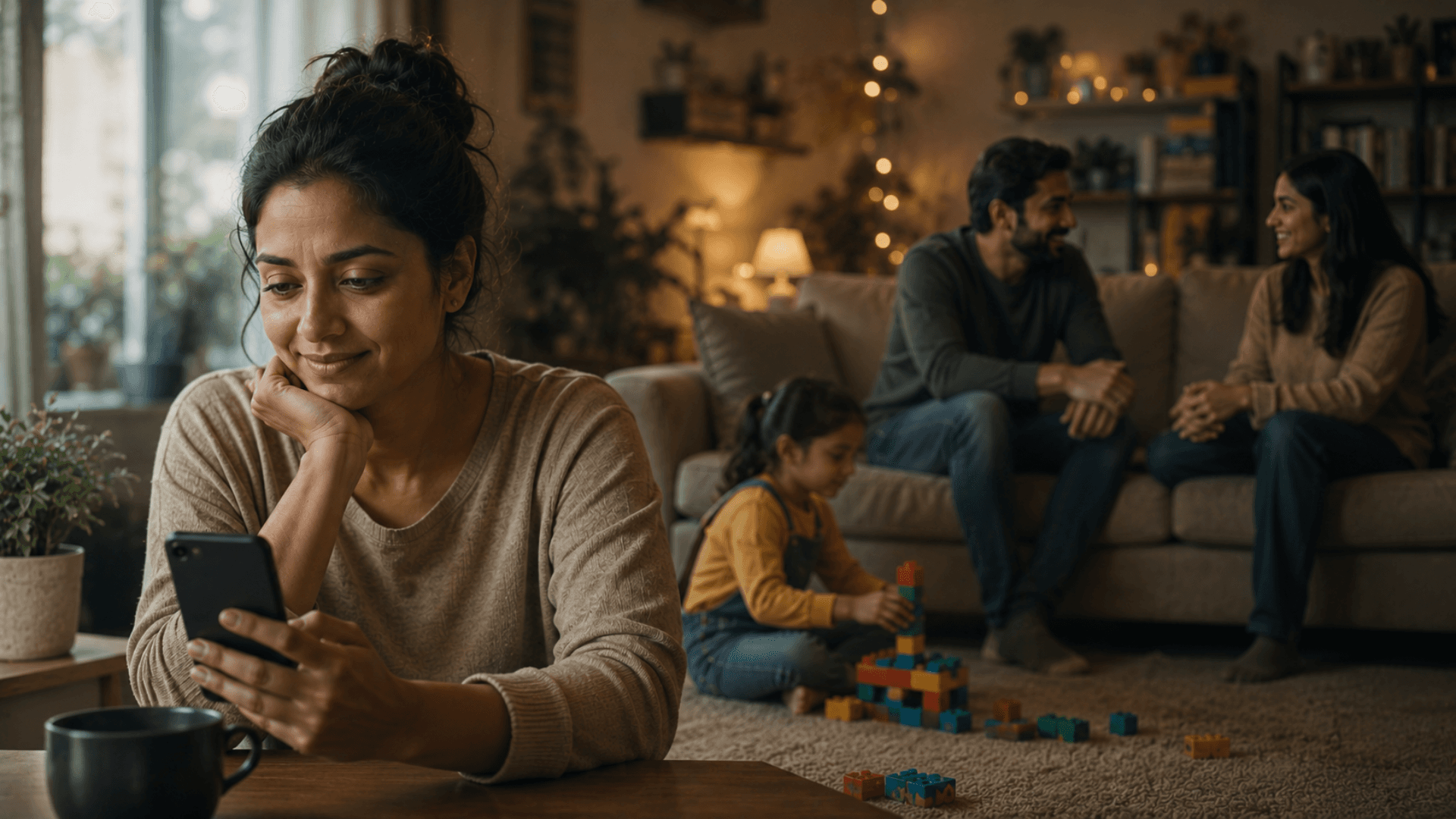
Ananya had 1,847 followers and, by her own honest count, three people she could call at 11 PM without rehearsing what to say first. For a long time, she had not really noticed the gap between those two numbers. The feed kept her occupied enough that she rarely sat with the question directly.
Then one evening, scrolling through a friend's engagement reception photos — a room full of people laughing, arms around each other, captions about "found family" and "forever people" — she felt a specific kind of loneliness that had nothing to do with being physically alone. She was, in fact, on her own couch, phone in hand, exactly the way she was most nights. What hit her was quieter and worse: the sense that everyone else seemed to have this — this ease, this abundance of people who showed up — and she had a follower count instead.
She did not delete her account that night. But she started counting, honestly, how many of those 1,847 people she had actually spoken to in the past month. The number was small enough to be uncomfortable. That discomfort is where deinfluencing friendships usually starts.
What "Deinfluencing" Actually Means Here
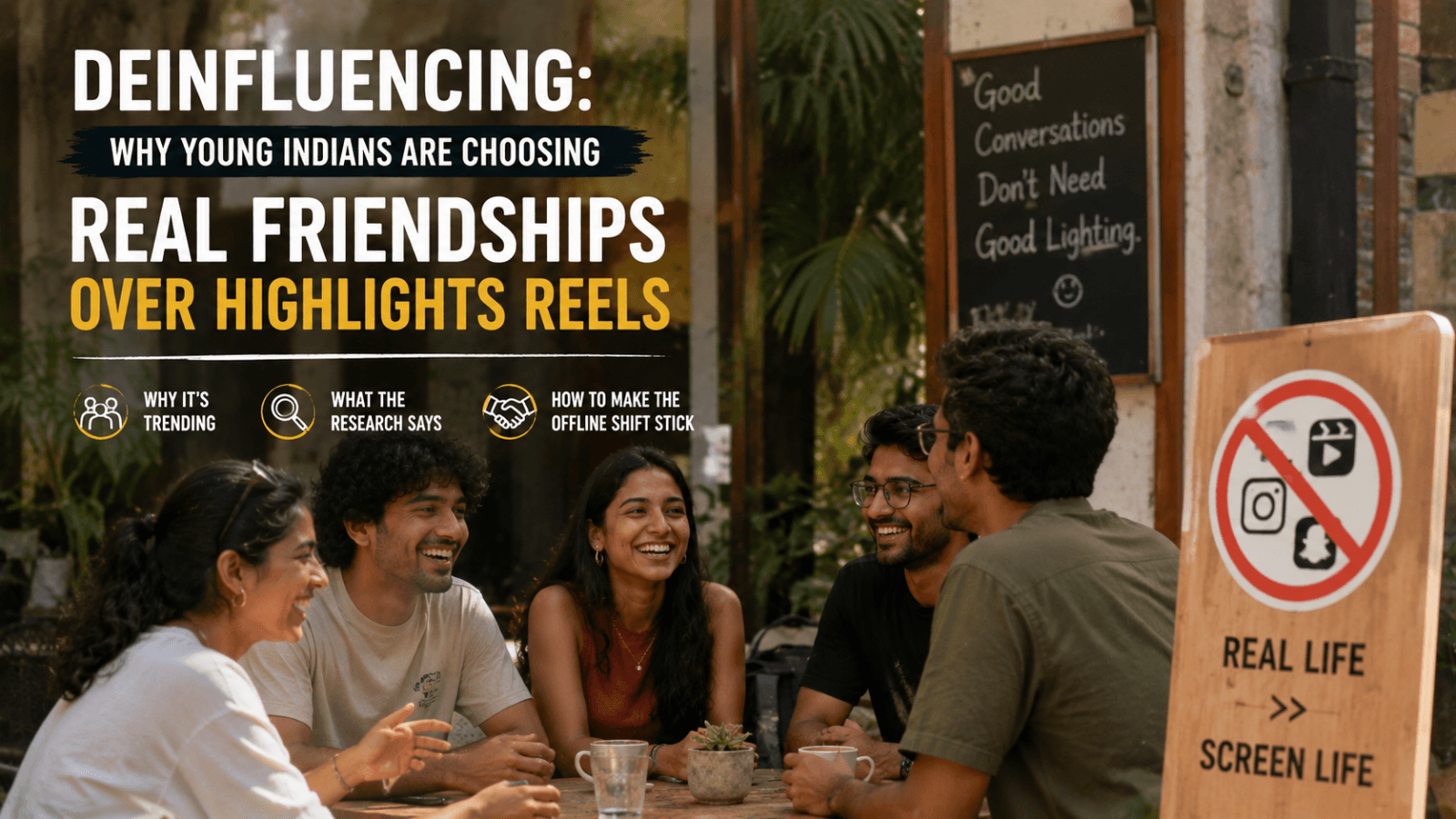
The term deinfluencing first showed up as a backlash to influencer culture — people posting "don't buy this" instead of "buy this," pushing back against the endless consumption cycle. The same instinct has quietly spread into how people think about their social lives. Deinfluencing your friendships means stepping back from the performance of connection — the tagged photos, the "besties" captions, the curated group chats — and asking a harder, more honest question: how many of these relationships would survive if the platform disappeared tomorrow.
It is not a rejection of technology altogether. Most people doing this are not deleting every app and moving to a cabin. It is a deliberate redirection of time and energy — away from maintaining a visible social image online, and toward the slower, less photogenic work of actually being present with a smaller number of people, in person, regularly.
Why This Is Happening in India Right Now
This shift is not happening in a vacuum. It is a fairly direct response to how deeply social media has embedded itself into Indian daily life over the past few years.
India's digital footprint has grown enormous by any measure. Indians spend an average of six hours and forty minutes daily on the internet, with roughly three and a half to four hours of that on smartphones specifically — among the highest usage figures globally. The scale of this shift has become significant enough that India's own Economic Survey 2025-26 formally flagged digital addiction as a structural concern for the first time, describing it as a quiet drag on learning, mental health, and economic output, and placing it alongside issues like obesity as a threat to human capital formation. A study specifically examining smartphone use among young adults in India found that nearly a quarter of respondents scored high enough on standard addiction measures to be classified as at-risk, with WhatsApp and other social networking apps accounting for the bulk of their time.
What makes this particularly relevant to friendship specifically is a 2025 study on Instagram use among Indian young adults, which found that both the sheer amount of time spent on the app and the specific type of content viewed independently predicted psychological distress — meaning it was not just how long people scrolled, but what they were scrolling through, that mattered.
Against this backdrop, it makes sense that some Indians — particularly young professionals and students already dealing with the ordinary loneliness of city life — are starting to draw a direct line between their feed and their sense of isolation, and deciding to do something about it.
Why the Feed Makes Real Friendship Feel Worse, Not Better
There is a specific psychological mechanism at play here, and it is worth naming clearly rather than treating this as vague "social media is bad" sentiment.
Research on social comparison within friendships has found that when people make upward comparisons to a friend — noticing that a friend appears to be doing better, socially or otherwise — it consistently predicts lower friendship satisfaction, lower closeness, and a more negative evaluation of the friendship itself. Social media is essentially a machine for generating upward comparisons on a loop: someone else's trip, someone else's group photo, someone else's "friendship anniversary" post. Even when nothing is objectively wrong with your own social life, the comparison itself erodes how good it feels.
There is also a quantity-versus-quality problem that researchers keep returning to. As one review of the psychology of friendship puts it plainly: a person with five hundred online contacts can be more socially isolated than a person with three close friends they actually know well, because social networks are not equal simply by virtue of being large. A feed full of "friends" measured by follower count creates the appearance of abundance while doing very little to build the kind of relationship that shows up for you at 11 PM.
None of this means social media use and friendship closeness are always in conflict — several studies on adult social media use have actually found no clear relationship between platform use and friendship quality, and some research even links certain messaging-heavy platforms to higher reported closeness. The honest picture is more specific than "social media ruins friendship": it is that passive, comparison-heavy scrolling of other people's curated lives displaces the mood and energy needed for the slower, effortful, in-person maintenance that real friendship actually runs on — even when total screen time itself is not the whole story.
What Deinfluencing Friendships Looks Like in Practice
This is rarely a single dramatic act. It tends to show up as a handful of smaller, deliberate shifts.
| Old Pattern | Deinfluenced Pattern |
|---|---|
| Liking a friend's post instead of texting them | Sending an actual message asking how they are doing |
| Measuring closeness by tagged photos and story mentions | Measuring closeness by who you'd call in an actual emergency |
| Scrolling a group's highlights instead of joining the next plan | Showing up to the next plan, even if it feels effortful |
| Comparing your weekend to everyone else's feed | Being present in your own weekend instead of narrating it |
| Maintaining a wide, low-effort online circle | Investing repeated, in-person time in a smaller circle |
| Using an app as the main venue for "keeping in touch" | Using in-person or voice contact as the default, apps as the backup |
None of these require deleting every account or performing a dramatic public "digital detox" announcement — which, ironically, is itself often just another form of social media performance. The quieter version simply redirects the hours that used to go into scrolling toward actually showing up for people.
Real Scenario: Devansh in Hinjewadi
Devansh had built what looked, from the outside, like an enviable social life — a large friend group visible in every tagged photo, regular appearances in other people's stories, a WhatsApp group with over forty members that pinged constantly. But he noticed a pattern he could not quite shake: on the actual days that went badly — a rough review at work, a fight with his parents — he had nobody in that large, visible circle he felt comfortable calling.
He tried an experiment, more out of curiosity than any grand plan. For one month, he stopped posting anything and cut his Instagram time to a strict ten minutes a day. He kept WhatsApp for logistics but stopped treating group chat activity as a substitute for actually meeting people. It was, for the first two weeks, uncomfortable — he felt oddly invisible, unsure what to do with the hour he used to spend scrolling.
That discomfort is what eventually pushed him toward a Stranger Mingle weekend trekking group near Hinjewadi, mostly because he needed something to physically do with the newly empty hour. The trek group was small — twelve people, no performance involved, nobody posting throughout. He went back the following two weekends, mostly to the same small cluster of people who had also shown up before.
By the end of that month, Devansh had not gained a bigger circle. He had, if anything, a smaller one. But it was a circle he had actually spent real hours with, in person, repeatedly — and it was the first time in a long while that he could name three people he would genuinely call on a bad day, rather than forty people who would like the post about it afterward.
What to Watch Out For
Deinfluencing your social life is not automatically healthy just because it involves less screen time. A few things are worth being honest about before treating this as a clean fix.
Isolation can disguise itself as intentionality. Quitting social media to build real friendships only works if the freed-up time actually goes toward people. Simply logging off without a plan for where that time goes can slide into isolation rather than connection — the goal is redirection, not subtraction.
It should not become another performance. Publicly announcing a "detox," documenting the process, or treating minimalism itself as a new identity to broadcast defeats the purpose. The quiet version — simply showing up more and posting less — tends to be the one that actually changes anything.
Family and long-distance relationships still need digital tools. This is not a case for rejecting technology broadly. Video calls with parents in another city, or maintaining a genuine long-distance friendship, are exactly the kind of digital connection worth keeping. The target is passive comparison scrolling, not connection itself.
It takes deliberate replacement, not just removal. Nature abhors a vacuum, and so does a Saturday evening. Freed-up time needs somewhere real to go — a recurring hangout, a class, a standing plan with people — or it tends to quietly refill with a different app instead.
Why In-Person, Repeated Contact Is the Part That Actually Works
If there is one consistent thread across the research on this topic, it is that friendship closeness is built through repeated, sustained, often unglamorous time spent together — not through visibility, and not through volume of contact. A feed can create the impression of a rich social life without providing any of the actual substance, while consuming exactly the hours that substance requires.
This is why deinfluencing friendships, done well, is not really an anti-technology stance. It is a redirection of a finite resource — attention and time — away from something that mimics connection and toward something that actually builds it. The follower count was never going to answer the phone at 11 PM. A person you have shown up for, more than once, might.
If you have found yourself doing the same quiet audit Ananya did — counting how many of your online connections would survive without the platform — the fix does not require becoming a hermit. It requires somewhere real to redirect that energy toward. Stranger Mingle runs weekly, in-person, no-performance-required events across Pune, Mumbai, Bengaluru, Hyderabad, and Delhi — treks, board game nights, hangouts — built for exactly this kind of shift, where nobody is posting and everybody is actually there.
Browse upcoming events in your city and spend a Saturday building the kind of friendship a highlights reel was never going to give you.