They Called Them Cockroaches. Twenty Million Strangers Said: Fine.
On 15 May 2026, inside a Supreme Court hearing room in New Delhi, the Chief Justice of India used a word that no judge should use for any citizen.
He called certain unemployed young people "cockroaches." Parasites of society. People with no place in any profession.
By the next morning, Abhijeet Dipke — a political communications strategist and Boston University student — had launched the Cockroach Janta Party on social media. The eligibility criteria for joining were: unemployed (by force or by choice), lazy (physically only), chronically online (minimum eleven hours a day), and capable of ranting professionally about things that matter.
Within seventy-eight hours, the Instagram account had crossed three million followers.
Within five days, it had crossed ten million — overtaking the official social media followings of parties that have been campaigning for decades.
Within two weeks: over twenty million followers, eight lakh membership sign-ups, six lakh signatures on a petition, a student wing, three formal spokespersons, and a planned protest at Jantar Mantar, Delhi.
A meme had become a movement. And the movement was made entirely of strangers.
What Is the Cockroach Janta Party (CJP)?
The Cockroach Janta Party — CJP, or कॉकरोच जनता पार्टी — is a satirical political movement founded on 16 May 2026 by Abhijeet Dipke. It is not registered with the Election Commission of India and makes no pretence of contesting elections in the conventional sense.
Its slogan: "Voice of the Lazy and Unemployed." Its ideology: political satire with a very serious edge. Its name: a deliberate parody of the ruling Bharatiya Janata Party.
The CJP's five formal demands are concrete and pointed — no Rajya Sabha seats for retired Chief Justices, prosecution under UAPA for vote deletion, fifty per cent women's reservation in Parliament and Cabinet, cancellation of media licences held by Ambani and Adani, and a twenty-year ban on political defectors.
These are not the demands of a comedy account. They are the articulated frustrations of a generation that has been watching institutional failure pile up — exam paper leaks, marking errors affecting millions of students, a job market that does not absorb its graduates, and a media environment that largely does not cover any of it honestly.
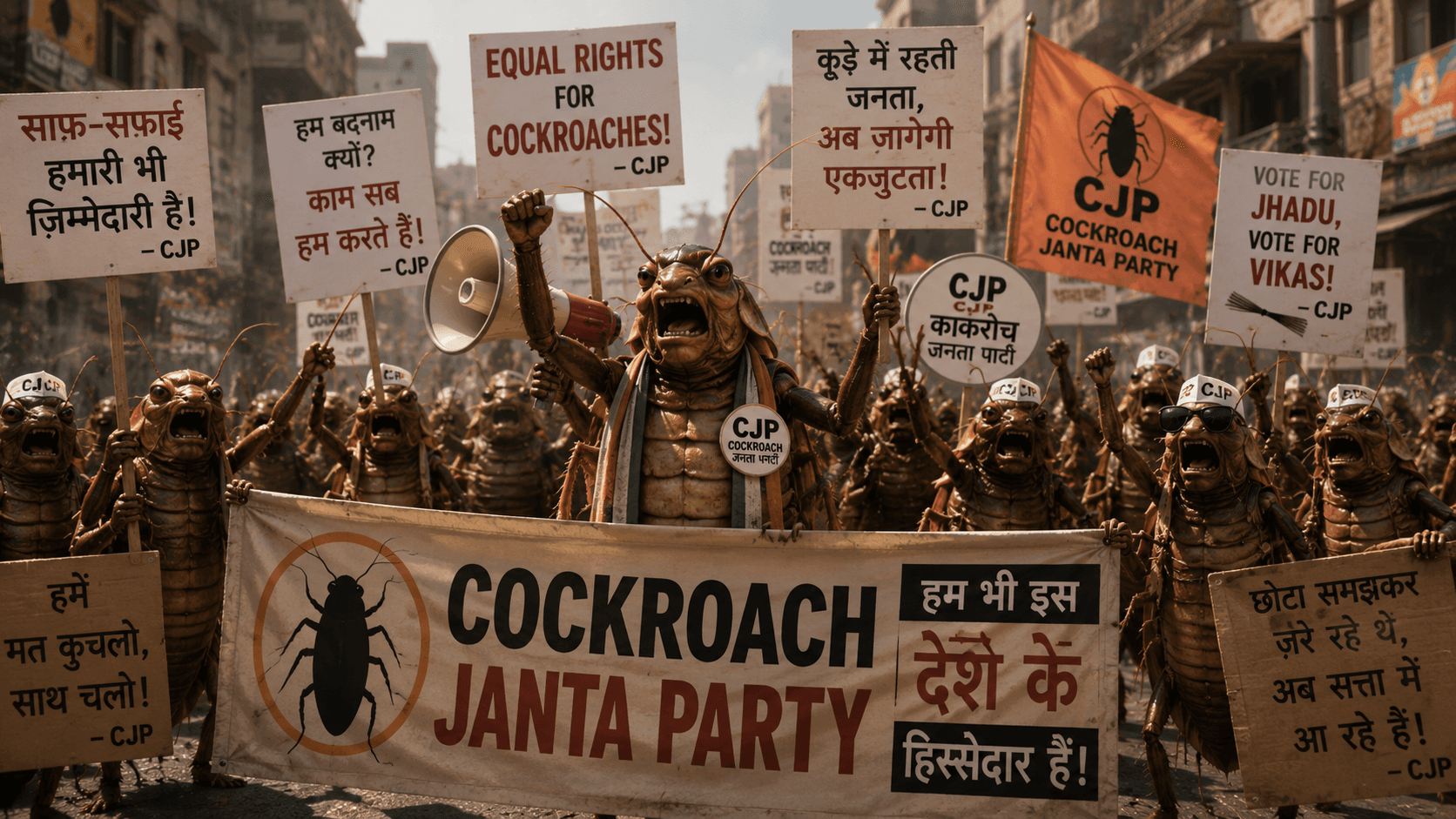
The CJP took that frustration and gave it a costume. Literally. Volunteers showed up to protests dressed as cockroaches.
And the government, evidently, found this more threatening than it wanted to admit.
What Happened When the Government Tried to Squash the Cockroaches
This is where the story becomes something larger than a viral moment.
Within days of the CJP's launch, the Indian government's Ministry of Electronics and Information Technology — MeitY — issued directives to block the movement's accounts. The X (formerly Twitter) handle of the CJP was blocked within India, citing national security concerns. The official website was taken down. Abhijeet Dipke reported that his personal Instagram account was hacked, as was the CJP's main Instagram page.
Dipke's response on X was a line that many shared without irony: "You can hack and withhold the accounts but you cannot hack this movement."
The blocks, the hacks, the government silence — and then the anonymous official who told The Indian Express that the Intelligence Bureau had flagged the CJP account as a threat to India's sovereignty — all of this had a paradoxical effect. Every crackdown made the cockroaches more numerous.
This is not surprising. It is historically consistent. When voices are silenced in public, they move underground — into private groups, anonymous chats, encrypted channels, community spaces where the label on the outside does not match what is happening on the inside.
The CJP is not just a viral moment. It is a case study in what happens when a generation of strangers — with no prior relationship, no shared geography, no common organisation — finds a signal they all recognise, and amplifies it together.
The Indian Strangers Movement: What CJP Actually Proved
Strip away the cockroach costumes and the meme format and what you have is something genuinely significant.
The CJP proved that Indian strangers, when given a shared language and a safe enough space to speak in, will show up in numbers that organised political parties spend decades trying to build.
They did not need to know each other. They did not need a party office, a WhatsApp group invitation, or a referral from a friend. They saw something true, recognised it, and joined it.
This is the strangers' movement in its purest form: not a network of existing relationships, but the spontaneous crystallisation of a shared experience into collective identity.
Consider who joined the CJP. They were students in Lucknow whose exam papers were leaked. They were engineers in Bengaluru applying to three hundred jobs and getting responses from none. They were graduates in Bhopal doing unpaid internships at twenty-four. They were young professionals in Mumbai earning salaries that have not kept pace with the rent increases of the past five years. They were in Hyderabad, in Surat, in Kanpur, in Nagpur.
They had never met. They shared nothing except the invisible weight of being told, explicitly or structurally, that they did not matter.
The CJP gave that feeling a name, a logo, and an absurdist rallying cry. And twenty million of them arrived.
Why Anonymity Was the Architecture of This Movement
Here is a fact worth sitting with: the CJP spread fastest in the period when no one was sure whether joining it was safe.
The accounts were getting blocked. The founder's personal pages were being compromised. The government had used the phrase "national security" to describe a party whose symbol was a cartoon cockroach. And still, people signed up in lakhs.
Why?
Because the movement gave people a degree of anonymity to begin with. You were not Rahul Sharma from Noida joining a protest. You were a cockroach. One of millions of cockroaches. The swarm was the identity — not the individual.
This is what anonymity does when it is designed thoughtfully. It lowers the cost of speaking. It removes the personal risk of being the visible, named, identifiable person who said the uncomfortable thing. It makes collective voice possible at a scale that individual named voice cannot reach.
The CJP showed, in real time and at a national scale, that Indian youth desperately need spaces where they can express what they actually think — about jobs, about institutions, about the daily reality of being young in India right now — without attaching their CV and full name to every word.
That need does not disappear when the meme cycle moves on. It is structural. It is permanent. And it is exactly what thoughtful, verified anonymous spaces are designed to address.
Anonymity Without Safety Is Just Noise: The Distinction That Matters
The CJP's anonymity was collective — which gave it both its power and its limitations. When the accounts were blocked, the individual members had no persistent home. The movement had to keep rebuilding its surface rather than deepening its roots.
This is the practical problem with purely anonymous, unverified public movements: they are very good at creating visibility and very fragile as community infrastructure.
Verified anonymous spaces work differently.
The anonymous chat on Stranger Mingle is built on a principle that the CJP demonstrated by accident: people speak more honestly, more freely, and more authentically when the social performance pressure of identity is temporarily lifted — but they need a foundation of real verification to feel safe doing so.
Every member in Stranger Mingle's anonymous chat is a verified, real individual. No bots. No fake accounts. No anonymous handles that belong to no one and are accountable to no one. The anonymity is between members — not between members and the platform. You appear as Stranger4821 to the person you are talking to. But you are a real person who has verified their identity and agreed to community guidelines.
This is the architecture that makes anonymous connection sustainable rather than chaotic.
| CJP Public Anonymity | Stranger Mingle Verified Anonymity |
|---|---|
| Open to anyone, no verification | Verified members only |
| Collective anonymous identity | Individual privacy protected within verified community |
| Vulnerable to account bans and hacks | Platform-stable, not dependent on a single social media account |
| Cannot build persistent community | Builds ongoing relationships within a real community |
| No moderation beyond platform rules | Active guidelines, zero-harassment policy, reporting system |
| Online only | Connects to real-world events across Indian cities |
What Indian Unemployed Youth Actually Need Right Now
The CJP articulated the frustration. But frustration articulated is not frustration resolved. Twenty million followers on Instagram does not pay anyone's rent or give anyone a job or replace the community that has quietly collapsed around an entire generation.
What do Indian unemployed youth — and the broader generation that identified with the CJP — actually need?
They need honest spaces to talk. Not performative spaces. Not curated Instagram realities. Spaces where you can say "I have applied to two hundred companies and I am genuinely scared about the future" without it becoming content that damages your professional reputation.
They need community that is not conditional on success. The social structures of college evaporate immediately after graduation. The structures of work are hierarchical, competitive, and not designed for friendship. The result is a generation that is deeply socially isolated despite being constantly online — and the CJP movement, ironically, is partly an expression of that isolation finding a temporary collective outlet.
They need to meet other people in the same situation — not to wallow together, but to discover, in a concrete and embodied way, that they are not uniquely failing. That the job market is genuinely broken. That the rent is objectively unaffordable. That the exam system genuinely failed millions of students. That their experience is shared, not personal.
This is why Stranger Mingle events — board game nights in Pune, heritage walks in Delhi, trekking groups in Bengaluru, social meetups in Hyderabad — draw exactly the crowd that the CJP movement represents. Young professionals. Recent graduates. People new to a city. People who moved for a job that turned out to be smaller than the promise. People who are figuring out what comes next and would very much like to do that figuring with other people rather than alone.
The Specific Value of Anonymous Chat for This Generation
The CJP spread because it gave Indian youth a way to say things they were not saying under their own names.
The anonymous chat on Stranger Mingle exists for the same essential reason — not for political satire, but for the quieter, equally real need to have genuine conversations without the performance layer that public identity requires.
Consider what someone in a Stranger Mingle anonymous chat can do that a CJP follower on Instagram cannot:
- Have a conversation that is not a public statement
- Talk to a real, verified person — not shout into a crowd
- Build an actual relationship rather than join a swarm
- Follow up, continue, deepen — not just react and scroll
- Transition from online conversation to real-world meetup at a Stranger Mingle event
- Have the conversation without it being indexed, screenshotted, and potentially weaponised
The CJP showed that twenty million Indians wanted to say something they had not been saying. The anonymous chat is for everything those same twenty million want to say next — to a specific real person, in private, without it becoming a news story.
Abhijeet Dipke and the Architecture of Stranger Movements
Abhijeet Dipke built the CJP in twenty-four hours with a Google form and a social media account. He was abroad, studying in Boston, watching India from a distance — and still managed to articulate something that millions of people inside India had been feeling but had not named.
This is the particular power of a stranger who is paying attention.
The best communities have always been built this way — not by insiders managing an existing network, but by someone on the periphery who notices the thing everyone is experiencing but nobody is saying, and builds a space for that unsaid thing to exist.
Stranger Mingle is built on the same observation. Urban India is full of people who are experiencing things — loneliness, professional anxiety, the particular hollowness of a city that has no room for you as a full person — that they are not saying to anyone. Not because they do not want to. Because they do not have a space to say it in without consequence.
The anonymous chat is that space. The events are where it becomes real.
From Cockroach to Community: What Comes After the Meme
Every movement faces the same inflection point. The moment when the viral energy either converts into something structural or dissipates into the content cycle's next story.
The CJP is at that inflection point right now. The protest at Jantar Mantar is a move toward structure. The student wing, the spokespersons, the formal demands — all moves toward something that can outlast an Instagram ban.
What the movement still needs is what all stranger movements eventually need: a community layer. A space where the twenty million people who share a common frustration can find each other not as followers of an account but as actual human beings with names, faces, and plans for Saturday.
That is not something a satirical political party can easily build. It is exactly what Stranger Mingle was built for.
If you are a CJP member — or someone who identified with the movement without signing up — and you are in Mumbai, Bengaluru, Pune, Delhi, Hyderabad, Chennai, Ahmedabad, Kolkata, Lucknow, or any of the other cities where Stranger Mingle operates, there is a community here that already understands why you showed up.
You do not have to explain why you are lonely in a crowded city. You do not have to justify wanting to meet real people without a dating app subtext. You do not have to perform optimism you do not feel.
You just have to show up. The anonymous chat is a good place to start.
Join the Stranger Mingle Community →
Why This Moment Is Not Just About Politics
It is important to say this clearly: the CJP is a political satire movement, and Stranger Mingle is not a political platform. We do not take positions on government actions, party politics, or the specific demands of the CJP or any other movement.
What we do take a position on is this: Indian youth deserve safe spaces to connect honestly — with each other, with strangers who might become friends, with a community that is not organised around performance or competition or professional networking.
The CJP lit up twenty million phones because it said something true about what young Indians are living. The truth it said was not fundamentally political. It was social. It was about being seen. About having your experience named. About not being alone in what you are carrying.
That is the need Stranger Mingle is built to meet — not through a meme or a manifesto, but through a board game night, a weekend trek, a heritage walk, and yes, an anonymous chat room where you can talk to a verified real person in your city at nine-thirty on a Wednesday evening without having to explain why you needed to talk to someone.
A Note on Anonymity and Safety
Because the CJP's experience demonstrated what happens to unprotected anonymous platforms in India — accounts hacked, websites blocked, personal information exposed — it is worth being explicit about how Stranger Mingle approaches this differently.
Our anonymous chat is anonymous between members, not anonymous to the platform. Every person in the chat has completed identity verification. Our zero-harassment policy is enforced actively, not aspirationally. There is a reporting system. There are consequences for violations.
This is not the kind of anonymity that gets exploited by bad actors or used as cover for harassment. It is the kind of anonymity that allows genuine people to have genuine conversations without the social risk that public identity carries.
Read our Safety Guidelines before joining. They are there not because we distrust our members, but because good community design makes expectations explicit before something goes wrong rather than after.
The Swarm That Wants to Meet
Here is the image that stays with you from the CJP movement.
Volunteers at protests, dressed in cockroach costumes. Strangers in Chennai and Nagpur and Vadodara and Jaipur who had never met, wearing the same absurd uniform, saying the same thing in different accents.
The cockroach costume was a way of saying: I am one of you. I am here. I showed up.
That impulse — to show up, to be physically present with people who share your experience, to move from scroll to real — is the same impulse that brings people to Stranger Mingle events every weekend across Indian cities.
The costume is optional. The showing up is the whole point.
The discounted membership is open right now. The anonymous chat is live. Events are happening this weekend in your city.
The swarm is welcome here.
See Upcoming Events Near You →
Stranger Mingle is a brand of Salty Media Production (opc) Pvt Ltd. We run verified, safe social events and community spaces for young professionals, students, and anyone who wants to meet real people in Indian cities. Our zero-harassment policy applies to all interactions on and off the platform.
This post discusses the Cockroach Janta Party (CJP) as a social and cultural phenomenon. Stranger Mingle does not endorse or represent any political movement or party.